


- Afhalen na 1 uur in een winkel met voorraad
- Gratis thuislevering in België vanaf € 30
- Ruim aanbod met 7 miljoen producten
- Afhalen na 1 uur in een winkel met voorraad
- Gratis thuislevering in België vanaf € 30
- Ruim aanbod met 7 miljoen producten




Omschrijving
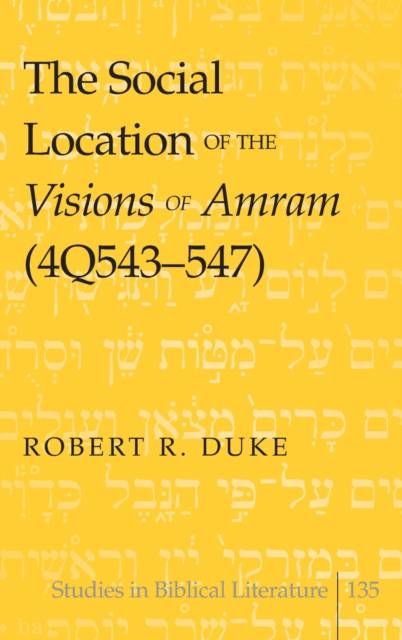
The Visions of Amram (4Q543-547), five copies of an Aramaic text found among the Dead Sea Scrolls, stems from the pre-Hasmonean period and provides evidence of a highly variegated society in early Judaism. In this book, Robert R. Duke offers a new reading of all the fragments and an in-depth discussion of their significance, illuminating a time period in Jewish history that needs more understanding and culminating in a suggested social location for its production. Duke concludes that 4Q543-547 was written by a disenfranchised group of priests who resided in Hebron. The importance of the patriarchal burials, chronology, endogamy, the figure of Moses, and angelology argue for a priestly group, whose members were also influenced by apocalyptic thinking. The suggestion of Hebron as the geographical location for this group is based on the theories of George Nickelsburg's and David Suter's work on 1 Enoch. Pre-Hasmonean Judaism was an intense time of dialogue and disagreement, and 4Q543-547 is one more item to consider in reconstructing these social realities.
Specificaties
Betrokkenen
- Auteur(s):
- Uitgeverij:
Inhoud
- Aantal bladzijden:
- 174
- Taal:
- Engels
- Reeks:
- Reeksnummer:
- nr. 135
Eigenschappen
- Productcode (EAN):
- 9781433107894
- Verschijningsdatum:
- 6/08/2010
- Uitvoering:
- Hardcover
- Formaat:
- Genaaid
- Afmetingen:
- 156 mm x 234 mm
- Gewicht:
- 439 g


Alleen bij Standaard Boekhandel
+ 350 punten op je klantenkaart van Standaard Boekhandel
Cadeau

AANGERADEN


Beoordelingen
We publiceren alleen reviews die voldoen aan de voorwaarden voor reviews. Bekijk onze voorwaarden voor reviews.