



Bedankt voor het vertrouwen het afgelopen jaar! Om jou te bedanken bieden we GRATIS verzending (in België) aan op alles gedurende de hele maand januari.
- Afhalen na 1 uur in een winkel met voorraad
- In januari gratis thuislevering in België
- Ruim aanbod met 7 miljoen producten
Bedankt voor het vertrouwen het afgelopen jaar! Om jou te bedanken bieden we GRATIS verzending (in België) aan op alles gedurende de hele maand januari.
- Afhalen na 1 uur in een winkel met voorraad
- In januari gratis thuislevering in België
- Ruim aanbod met 7 miljoen producten





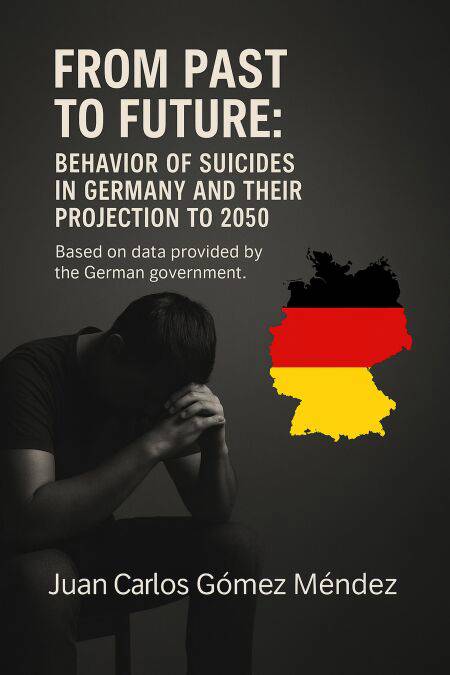
From the Past to the Future: Suicide Behavior in Germany and its Projection to 2050 E-BOOK
Research published in English, #7
Juan Carlos Gómez Méndez
€ 12,99
+ 12 punten
Omschrijving
Suicide in Germany constitutes a serious social and family challenge, affecting not only those who commit it but also their closest circles and the overall social structure. Current figures show an average of more than 10,000 suicides annually, equivalent to dozens of cases per day, with a significant gender gap, where the male rate is approximately three times higher than the female rate. This disparity highlights cultural, psychological, and social factors that require urgent and sustained intervention.
Historical suicide data in Germany spanning more than two decades were analyzed using statistical tests such as Shapiro-Wilk to assess normality, ANOVA for gender differences, and Pearson correlation for time-related trends. Results confirm a stable yet high incidence, with moderate variability and a distribution indicating that the phenomenon is structural and persistent.
Projection models estimate that, even under optimistic scenarios, suicide will remain a critical public health and social issue for decades to come, with potential impact beyond 2050. This outlook underscores the need for comprehensive strategies, including prevention programs, psychological care, and strengthening family and community support networks, to reduce incidence and close the gender gap. Suicide is not only an individual tragedy but a systemic crisis that threatens emotional stability and social cohesion in contemporary and future societies.
Specificaties
Betrokkenen
- Auteur(s):
- Uitgeverij:
Inhoud
- Taal:
- Engels
- Reeks:
Eigenschappen
- Productcode (EAN):
- 9798227953216
- Verschijningsdatum:
- 15/08/2024
- Uitvoering:
- E-book
- Formaat:
- ePub


Alleen bij Standaard Boekhandel
+ 12 punten op je klantenkaart van Standaard Boekhandel
SOLDEN


Beoordelingen
We publiceren alleen reviews die voldoen aan de voorwaarden voor reviews. Bekijk onze voorwaarden voor reviews.