


- Afhalen na 1 uur in een winkel met voorraad
- Gratis thuislevering in België vanaf € 30
- Ruim aanbod met 7 miljoen producten
- Afhalen na 1 uur in een winkel met voorraad
- Gratis thuislevering in België vanaf € 30
- Ruim aanbod met 7 miljoen producten





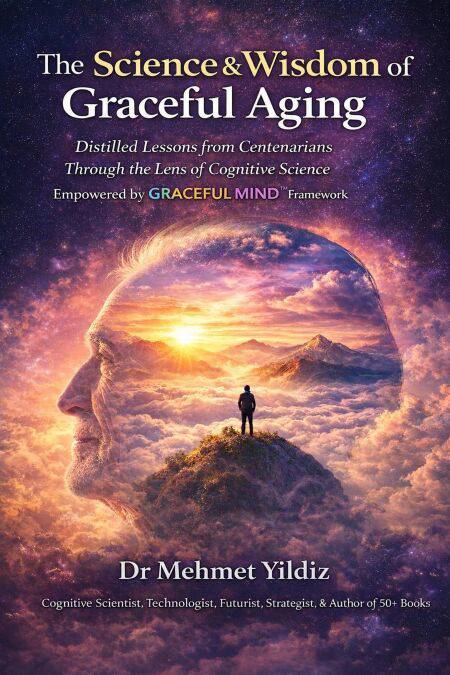
The Science and Wisdom of Graceful Aging: Distilled Lessons from Centenarians Through the Lens of Cognitive Science E-BOOK
Dr Mehmet Yildiz
E-book | Engels
€ 17,49
+ 17 punten
Omschrijving
For decades, I've studied the brain, human behavior, metabolism, stress physiology, and the patterns that shape long-term health.
I have also observed that some people grow older with remarkable clarity, strength, and emotional steadiness, while others decline far earlier than expected. This difference does not look accidental to me.
This book grew out of a profound question I kept asking myself: Why do some individuals remain mentally sharp, physically capable, and socially meaningful well into advanced age, while others lose coherence decades earlier?
Aging is inevitable, but I believe that decline is not a fixed destiny. So I focus on healthspan rather than lifespan.
In this new book, I bring together cognitive science, neuroscience, metabolic research, and distilled lessons from centenarians to offer a structured way of thinking about aging. I do not chase trends or promise shortcuts.
Instead, I integrate decades of scientific literature, lived observation, personal experimentation, and conversations with high performers and long-lived individuals who have preserved vitality across time.
At the center of this work is my GRACEFUL MIND™ Framework, a twelve-pillar model I designed to support biological stability and psychological coherence across decades.
The GRACEFUL MIND™ Framework stands for: Genomic Stewardship, Recovery Rhythms, Autonomic Balance, Cognitive Plasticity, Emotional Integration, Fuel Flexibility, Useful Contribution, Limbic Harmony, Muscular Vitality, Inflammatory, Modulation, Narrative Coherence, Design Over Drift.
Each pillar represents a dimension of aging that modern science now recognizes as essential.
At a high level, DNA repair capacity influences longevity. Circadian alignment shapes metabolic regulation. Autonomic tone affects stress resilience. Muscle acts as a metabolic and endocrine organ. Chronic low-grade inflammation accelerates cognitive erosion. Emotional processing influences autonomic balance. Purpose alters physiological stress responses.
These systems interact continuously. When aligned, they build resilience. When neglected, they compound fragmentation.
I frame aging as a design challenge rather than a passive biological event. Biology keeps a record of our habits. Small daily patterns accumulate into measurable biological outcomes.
I answer questions like: How we structure recovery, how we regulate stress, how we move, how we eat, how we learn, how we interpret adversity, and how we contribute to others shape our trajectory over time.
In this book, I bridge molecular biology and meaning. I explain how mitochondria influence mood and cognition, how muscle protects metabolic health, how inflammation erodes neural networks, how grief reshapes autonomic tone, and how narrative coherence protects psychological stability.
My aim is to translate complex mechanisms into a clear, practical understanding without diluting scientific integrity.
You will find a cognitive science lens on longevity, practical guidance grounded in metabolic and neurological research, and a structured framework to evaluate your own aging trajectory.
I also explore how lessons from centenarians can be interpreted through modern science and what emerging developments toward 2050 may mean for mitochondrial psychiatry, precision aging, and cognitive preservation.
I wrote this book for people of any age, including professionals, lifelong learners, and anyone who values evidence, responsibility, and long-term thinking.
Graceful aging, in my view, involves preserving coherence over time. It involves building strength without rigidity and wisdom without resignation. It involves contribution rather than withdrawal.
Specificaties
Betrokkenen
- Auteur(s):
- Uitgeverij:
Inhoud
- Taal:
- Engels
Eigenschappen
- Productcode (EAN):
- 9798233705304
- Verschijningsdatum:
- 29/04/2026
- Uitvoering:
- E-book
- Formaat:
- ePub


Alleen bij Standaard Boekhandel
+ 17 punten op je klantenkaart van Standaard Boekhandel
Cadeau

AANGERADEN


Beoordelingen
We publiceren alleen reviews die voldoen aan de voorwaarden voor reviews. Bekijk onze voorwaarden voor reviews.