


- Afhalen na 1 uur in een winkel met voorraad
- Gratis thuislevering in België vanaf € 30
- Ruim aanbod met 7 miljoen producten
- Afhalen na 1 uur in een winkel met voorraad
- Gratis thuislevering in België vanaf € 30
- Ruim aanbod met 7 miljoen producten





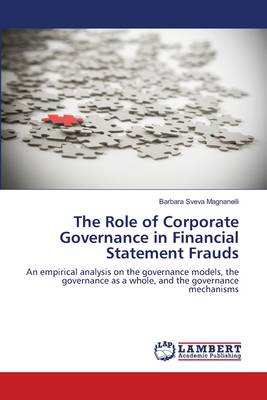
The Role of Corporate Governance in Financial Statement Frauds
An empirical analysis on the governance models, the governance as a whole, and the governance mechanisms
Barbara Sveva Magnanelli
Paperback | Engels
€ 58,45
+ 116 punten
Omschrijving
The attention on corporate governance, and the role played by it within the companies, has been increasing significantly in the recent years due to the numerous financial statement frauds that occurred. Both academics and practitioners have started to question if the corporate governance has a responsibility in the fraud occurrence and which could be the most relevant factors that can induce fraudulent behaviors. This book has the aim to provide a deep analysis of the causes of the financial statement frauds, taking into account specifically the corporate governance systems in which the firms operate. Different cultural contexts, characterized by various governance models, are analyzed. An empirical analysis of the governance as a whole at first, and of the single governance mechanisms later, is conducted, providing interesting findings on the major governance lacks and failures that could lead to a financial statement fraud occurrence, or at least that could increase the likelihood of its occurrence.
Specificaties
Betrokkenen
- Auteur(s):
- Uitgeverij:
Inhoud
- Aantal bladzijden:
- 160
- Taal:
- Engels
Eigenschappen
- Productcode (EAN):
- 9783659201769
- Verschijningsdatum:
- 31/07/2012
- Uitvoering:
- Paperback
- Afmetingen:
- 152 mm x 229 mm
- Gewicht:
- 257 g


Alleen bij Standaard Boekhandel
+ 116 punten op je klantenkaart van Standaard Boekhandel
Cadeau

AANGERADEN


Beoordelingen
We publiceren alleen reviews die voldoen aan de voorwaarden voor reviews. Bekijk onze voorwaarden voor reviews.