


- Afhalen na 1 uur in een winkel met voorraad
- Gratis thuislevering in België vanaf € 30
- Ruim aanbod met 7 miljoen producten
- Afhalen na 1 uur in een winkel met voorraad
- Gratis thuislevering in België vanaf € 30
- Ruim aanbod met 7 miljoen producten





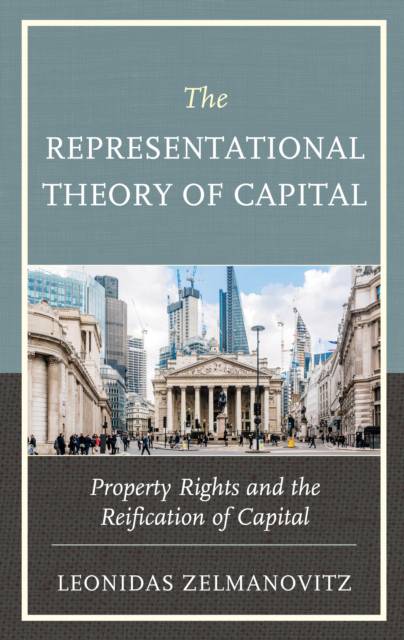
The Representational Theory of Capital
Property Rights and the Reification of Capital
Leonidas Zelmanovitz
Paperback | Engels
€ 72,95
+ 145 punten
Omschrijving
This book proposes a "representational" theory of capital according to which there is a relation between capital goods in the real side of the economy and instruments representative of property claims on those goods in the abstract side. Financial instruments are treated herein as a particularly liquid form of property claim. The relation proposed between these two things is a loose rather than a direct one, and the causes for (and consequences of) the looseness are explored in the book. This book aims not merely to simplify our understanding of the relationship between "things" and "claims to things," but to make explicit and precise what many current researchers assume implicitly and, consequently, imprecisely. This book will be a tool that researchers can apply to their own research, in the form of a standard by which inconsistencies in the literature on Capital Theory can be identified. Understanding what capital is requires delving into its nature on both the real and the abstract sides. In regard to capital goods, what they actually are is made clearer by the thesis that they exist on a spectrum with respect to consumer goods. In going back to the philosophical and economic basics, no claim is made of being comprehensive. The argument is that a crucial idea for our understanding of what capital is that actual capital goods (and processes, and knowledge) are represented in financial instruments and other property claims. A formal treatment that lays out the philosophical and economic basics is necessary to put this idea across, and the model proposed in the book is a first step in that direction. Further, by laying out the philosophical and economic basics of the theory, the book offers the reader the reasons why having a clearer concept of capital is an important tool for wealth creation, and why wealth creation is, more than never, necessary for our individual wellbeing and the flourishing of our civilization.
Specificaties
Betrokkenen
- Auteur(s):
- Uitgeverij:
Inhoud
- Aantal bladzijden:
- 264
- Taal:
- Engels
Eigenschappen
- Productcode (EAN):
- 9781793605023
- Verschijningsdatum:
- 10/05/2022
- Uitvoering:
- Paperback
- Formaat:
- Trade paperback (VS)
- Afmetingen:
- 152 mm x 229 mm
- Gewicht:
- 358 g



Alleen bij Standaard Boekhandel
+ 145 punten op je klantenkaart van Standaard Boekhandel
Cadeau

AANGERADEN


Beoordelingen
We publiceren alleen reviews die voldoen aan de voorwaarden voor reviews. Bekijk onze voorwaarden voor reviews.