


- Afhalen na 1 uur in een winkel met voorraad
- Gratis thuislevering in België vanaf € 30
- Ruim aanbod met 7 miljoen producten
- Afhalen na 1 uur in een winkel met voorraad
- Gratis thuislevering in België vanaf € 30
- Ruim aanbod met 7 miljoen producten





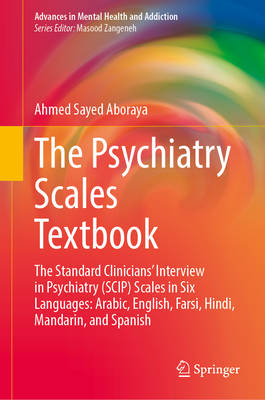
The Psychiatry Scales Textbook
The Standard Clinicians' Interview in Psychiatry (Scip) Scales in Six Languages: Arabic, English, Farsi, Hindi, Mandarin, and Spanish
Ahmed Sayed Aboraya
€ 129,95
+ 259 punten
Omschrijving
This book aims to encourage the use of the SCIP scales in clinical settings. The SCIP was developed as a measurement-based care (MBC) tool to help clinicians diagnose mental disorders, assess their severity, and guide clinical decision-making. One of its key features is the application of simple, consistent measurement rules across all scales, making it particularly useful for patients with comorbid conditions--a common occurrence in psychiatric populations. For instance, patients with depression often also experience anxiety and panic, while those with schizophrenia may suffer from mood swings, depression, and substance use disorders. Mental health professionals value the convenience of using a single instrument that includes 18 clinician-administered (CA) scales, covering most adult psychiatric domains, and 15 self-administered (SA) scales that patients can complete prior to evaluation. Each scale takes only 2-5 minutes for a clinician to administer. This book supports research efforts by including research versions of 18 SCIP scales. While these research versions feature the same questions as their clinical counterparts, they also include additional questions designed specifically for research purposes. Mental health researchers can easily integrate them into their studies. Most importantly, this book also makes the SCIP scales accessible to over four billion people worldwide who speak six major languages: Arabic, English, Farsi, Hindi, Mandarin, and Spanish. The SCIP scales were translated from English into these five target languages using Machine Translation Post-Editing (MTPE), where bilingual experts carefully reviewed and refined the machine-generated translations to ensure linguistic, contextual, cultural, and semantic accuracy. Providing culturally appropriate translations of the SCIP scales will improve clinical services and expand research opportunities in diverse linguistic and cultural contexts. The target audience for this book includes mental health professionals--such as psychiatrists, psychiatry residents, psychologists, therapists, clinical social workers, counsellors, nurses, nurse practitioners, and physician assistants--who are motivated to integrate the SCIP scales into their practice.
Specificaties
Betrokkenen
- Auteur(s):
- Uitgeverij:
Inhoud
- Aantal bladzijden:
- 262
- Taal:
- Engels
- Reeks:
Eigenschappen
- Productcode (EAN):
- 9783032223272
- Verschijningsdatum:
- 2/07/2026
- Uitvoering:
- Hardcover
- Formaat:
- Genaaid
- Afmetingen:
- 155 mm x 235 mm


Alleen bij Standaard Boekhandel
+ 259 punten op je klantenkaart van Standaard Boekhandel
Cadeau

AANGERADEN


Beoordelingen
We publiceren alleen reviews die voldoen aan de voorwaarden voor reviews. Bekijk onze voorwaarden voor reviews.