


- Afhalen na 1 uur in een winkel met voorraad
- Gratis thuislevering in België vanaf € 30
- Ruim aanbod met 7 miljoen producten
- Afhalen na 1 uur in een winkel met voorraad
- Gratis thuislevering in België vanaf € 30
- Ruim aanbod met 7 miljoen producten





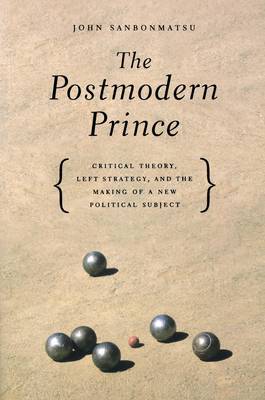
The Postmodern Prince
Critical Theory, Left Strategy, and the Making of a New Political Subject
John Sanbonmatsu
Paperback | Engels
€ 50,95
+ 101 punten
Uitvoering
Omschrijving
John Sanbonmatsu's Postmodern Prince is a work of political theory with a focus on questions of strategy. At the same time it provides an original and illuminating intellectual history of the Left from the 1960s to the present. It examines the politics of the New Left in the 1960s, showing how its expressivism led to political division and also prepared the ground for postmodernism. It shows also how the political economy of academic life in an increasingly commodified society strengthened the basis of postmodernism. The Postmodern Prince provides a historically-grounded critique of postmodernism, and a history of how the socialist Left has helped to create its ideas. In the course of this two-sided critique, it develops a brilliant account of a Marxism that sets itself the task of building a collective political subject-a successor to Machiavelli's Prince and Gramsci's Modern Prince-capable of challenging capitalism in its moment of global crisis. Sanbonmatsu demonstrates the limitations of the work of Michel Foucault, and more recently, Hardt and Negri's much-acclaimed Empire. In the process he validates for Marxism the classical idea of politics as hegemonic in scope, revolutionary in aspiration, and dependent on the capacity of leadership to rise to unforeseen challenges. He draws on an extraordinary range of historical, political and philosophical analyses to set out the preconditions for a renewal of strategic and theoretical vision for the Left.
Specificaties
Betrokkenen
- Auteur(s):
- Uitgeverij:
Inhoud
- Aantal bladzijden:
- 274
- Taal:
- Engels
Eigenschappen
- Productcode (EAN):
- 9781583670903
- Verschijningsdatum:
- 1/08/2003
- Uitvoering:
- Paperback
- Formaat:
- Trade paperback (VS)
- Afmetingen:
- 151 mm x 227 mm
- Gewicht:
- 376 g


Alleen bij Standaard Boekhandel
+ 101 punten op je klantenkaart van Standaard Boekhandel

Beoordelingen
We publiceren alleen reviews die voldoen aan de voorwaarden voor reviews. Bekijk onze voorwaarden voor reviews.