


- Afhalen na 1 uur in een winkel met voorraad
- Gratis thuislevering in België vanaf € 30
- Ruim aanbod met 7 miljoen producten
- Afhalen na 1 uur in een winkel met voorraad
- Gratis thuislevering in België vanaf € 30
- Ruim aanbod met 7 miljoen producten





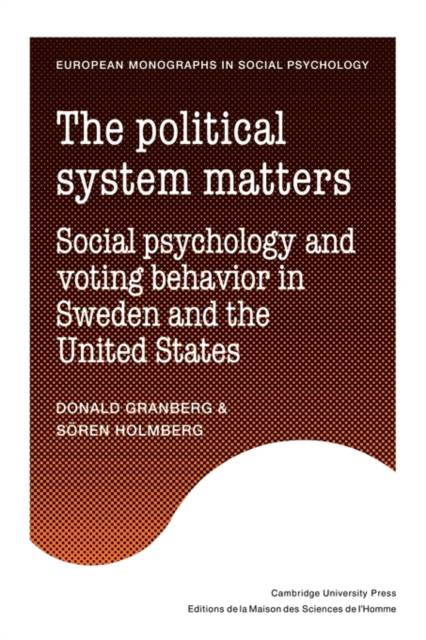
The Political System Matters
Social Psychology and Voting Behavior in Sweden and the United States
Donald Granberg, Soren Holmberg, Granberg Donald
€ 67,95
+ 135 punten
Eenvoudig bestellen
Veilig betalen


Gratis thuislevering vanaf € 30 (via bpost)
Gratis levering in je Standaard Boekhandel
Omschrijving
Originally published in 1988, this book asks the question, how does the political system affect the behaviour of individuals? Donald Granberg and Sören Holmberg use long-term cross-sectional and panel national surveys of electorates in two very different democratic systems - Sweden and the United States - to examine an issue that has implications for our understanding of both social and psychological processes and also political systems in general. Their interdisciplinary and comparative survey considers such topics as ideological perception of abstract and concrete issues at the party and individual level; the polarisation, interrelation and transitivity of attitudes; the relationship between intention and behaviour; and the ways in which behaviour may be predicted. The book offers a detailed and convincing analysis of the interaction of political context with social psychological processes. It will be of interest not only to social, political and comparative psychologists, but also to all researchers with an interest in electoral behaviour.
Specificaties
Betrokkenen
- Auteur(s):
- Uitgeverij:
Inhoud
- Aantal bladzijden:
- 268
- Taal:
- Engels
- Reeks:
Eigenschappen
- Productcode (EAN):
- 9780521125840
- Verschijningsdatum:
- 14/01/2010
- Uitvoering:
- Paperback
- Formaat:
- Trade paperback (VS)
- Afmetingen:
- 152 mm x 229 mm
- Gewicht:
- 394 g


Alleen bij Standaard Boekhandel
+ 135 punten op je klantenkaart van Standaard Boekhandel
CADEAU

AANGERADEN


Beoordelingen
We publiceren alleen reviews die voldoen aan de voorwaarden voor reviews. Bekijk onze voorwaarden voor reviews.