


- Afhalen na 1 uur in een winkel met voorraad
- Gratis thuislevering in België vanaf € 30
- Ruim aanbod met 7 miljoen producten
- Afhalen na 1 uur in een winkel met voorraad
- Gratis thuislevering in België vanaf € 30
- Ruim aanbod met 7 miljoen producten






€ 14,22
+ 28 punten
Omschrijving
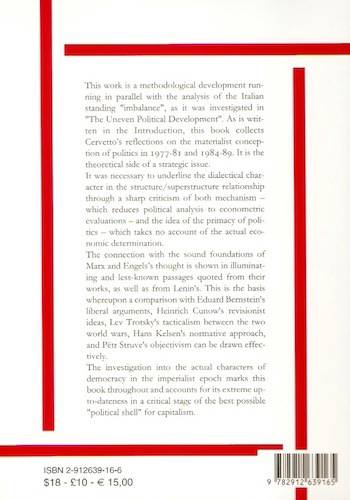
This work is a methodological development running in parallel with the analysis of the Italian standing “imbalance”, as it was investigated in “The Uneven Political Development”. As is written in the Introduction, this book collects Cervetto’s reflections on the materialist conception of politics in 1977-81 and 1984-89. It is the theoretical side of a strategic issue.
It was necessary to underline the dialectical character in the structure/superstructure relationship through a sharp criticism of both mechanism – which reduces political analysis to econometric evaluations – and the idea of the primacy of politics – which takes no account of the actual economic determination.
The connection with the sound foundations of Marx and Engels’s thought is shown in illuminating and less-known passages quoted from their works, as well as from Lenin’s. This is the basis whereupon a comparison with Eduard Bernstein’s liberal arguments, Heinrich Cunow’s revisionist ideas, Lev Trotsky’s tacticalism between the two world wars, Hans Kelsen’s normative approach, and Pëtr Struve’s objectivism can be drawn effectively.
The investigation into the actual characters of democracy in the imperialist epoch marks this book throughout and accounts for its extreme up-to-dateness in a critical stage of the best possible “political shell” for capitalism.
It was necessary to underline the dialectical character in the structure/superstructure relationship through a sharp criticism of both mechanism – which reduces political analysis to econometric evaluations – and the idea of the primacy of politics – which takes no account of the actual economic determination.
The connection with the sound foundations of Marx and Engels’s thought is shown in illuminating and less-known passages quoted from their works, as well as from Lenin’s. This is the basis whereupon a comparison with Eduard Bernstein’s liberal arguments, Heinrich Cunow’s revisionist ideas, Lev Trotsky’s tacticalism between the two world wars, Hans Kelsen’s normative approach, and Pëtr Struve’s objectivism can be drawn effectively.
The investigation into the actual characters of democracy in the imperialist epoch marks this book throughout and accounts for its extreme up-to-dateness in a critical stage of the best possible “political shell” for capitalism.
Specificaties
Betrokkenen
- Auteur(s):
- Uitgeverij:
Inhoud
- Aantal bladzijden:
- 290
- Taal:
- Engels
Eigenschappen
- Productcode (EAN):
- 9782912639165
- Verschijningsdatum:
- 1/01/2006
- Uitvoering:
- Paperback
- Afmetingen:
- 150 mm x 210 mm
- Gewicht:
- 354 g



Alleen bij Standaard Boekhandel
+ 28 punten op je klantenkaart van Standaard Boekhandel
CADEAU

AANGERADEN


Beoordelingen
We publiceren alleen reviews die voldoen aan de voorwaarden voor reviews. Bekijk onze voorwaarden voor reviews.