


- Afhalen na 1 uur in een winkel met voorraad
- Gratis thuislevering in België vanaf € 30
- Ruim aanbod met 7 miljoen producten
- Afhalen na 1 uur in een winkel met voorraad
- Gratis thuislevering in België vanaf € 30
- Ruim aanbod met 7 miljoen producten





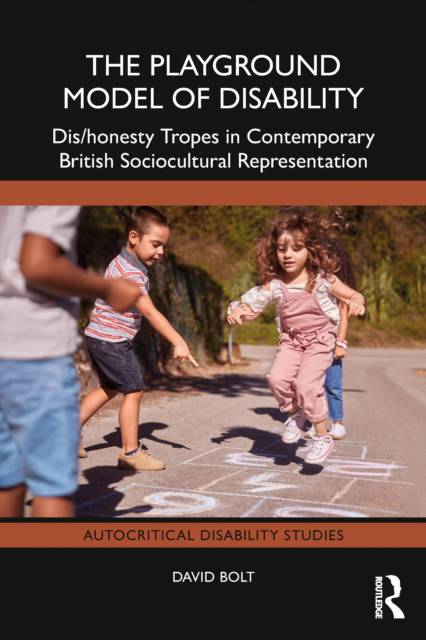
The Playground Model of Disability
Dis/Honesty Tropes in Contemporary British Sociocultural Representation
David Bolt
€ 56,95
+ 113 punten
Uitvoering
Omschrijving
More than being counter to what we must surely endeavour to consider the status quo of honesty, not to mention the pursuit of truth that should still be fundamental in academia and education more broadly, dishonesty involves deceit and thus victimisation, which is to say it tends to be used either against someone or to give someone an unfair advantage. Such personal interactions are sometimes and, in the context of this book, revealingly referred to as the games people play.
When an unfair advantage is so given, someone else tends to be disadvantaged, an aspect of dishonesty that resonates with disablement. This book coins the term dis/honesty to define the many moments in which dishonesty is invoked by disability, and vice versa. The concept is explored via a selection of contemporary British sociocultural representations - namely, short jokes, disability sitcom, soap opera, activist radio interviews, fictionalised observations, and the robotic positionality of Artificial Intelligence.
In investigating these representations of dis/honesty, on the basis that the blueprint of adult behaviour is found in the schoolyard, playground figurations are posited as part of the autocritical framework. Remarkably, there are many such relationships with disablement, for intrinsic to Piggy in the Middle, Leapfrog, Pile On, Hide and Seek, Blind Man's Bluff, and Robot Tick, among other playground games, is interpersonal inequity, whereby a normative position is juxtaposed with one defined by being outnumbered, inhibited, and/or singled out.
The playground model of disability reveals normative traditions that, according to a range of recent representations, people are often more than tempted to follow. Like a hegemonic game of Hopscotch, the way of the normative social order is sketched before us, complete with behavioural guidelines legitimised by repetition and competition. This book shows how dis/honesty tropes serve the normative social order and how the playground model can be used to critique instances in which disablement emanates from interactions more than institutions, people more than places.
The Playground Model of Disability: Dis/honesty Tropes in Contemporary British Sociocultural Representation will be of particular interest to readers in disability studies, as well as those in humour studies, radio studies, media studies, television studies, literary studies, cultural studies, inclusion studies, drama, sociology, and critical theory.
Specificaties
Betrokkenen
- Auteur(s):
- Uitgeverij:
Inhoud
- Aantal bladzijden:
- 110
- Taal:
- Engels
- Reeks:
Eigenschappen
- Productcode (EAN):
- 9781041064923
- Verschijningsdatum:
- 14/10/2025
- Uitvoering:
- Paperback
- Formaat:
- Trade paperback (VS)
- Afmetingen:
- 156 mm x 234 mm
- Gewicht:
- 199 g


Alleen bij Standaard Boekhandel
+ 113 punten op je klantenkaart van Standaard Boekhandel
Cadeau

AANGERADEN


Beoordelingen
We publiceren alleen reviews die voldoen aan de voorwaarden voor reviews. Bekijk onze voorwaarden voor reviews.