


- Afhalen na 1 uur in een winkel met voorraad
- Gratis thuislevering in België vanaf € 30
- Ruim aanbod met 7 miljoen producten
- Afhalen na 1 uur in een winkel met voorraad
- Gratis thuislevering in België vanaf € 30
- Ruim aanbod met 7 miljoen producten





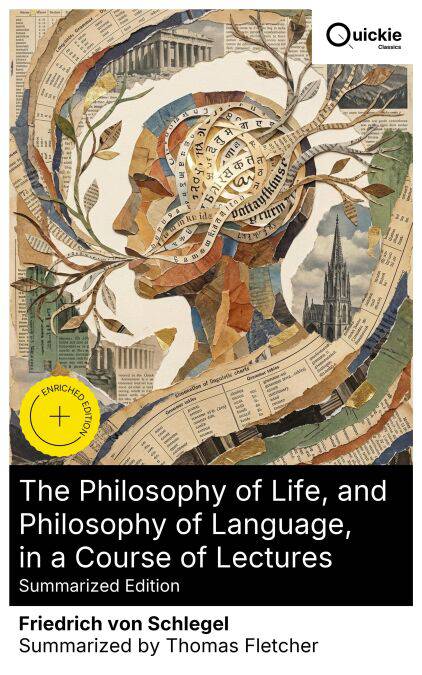
The Philosophy of Life, and Philosophy of Language, in a Course of Lectures (Summarized Edition) E-BOOK
Enriched edition. Words as Life's Organ: Romantic Philology from Myth to Comparative Grammar
Friedrich von Schlegel
E-book | Engels
€ 1,99
+ 1 punten
Eenvoudig bestellen
Veilig betalen


Onmiddellijk geleverd via e-mail
Omschrijving
This capacious course of lectures binds a philosophy of life to a philosophy of language, claiming that vitality is the formative principle of nature, history, and art, and that speech is life's luminescent organ. Ranging from myth to etymology and comparative grammar, Schlegel traces how languages grow, differentiate, and embody national spirit while mediating thought. The lectures move with Romantic breadth—at once aphoristic and systematic—synthesizing philology and cultural history. Set within late German Romanticism and conversing with Herder, Humboldt, and post‑Kantian Naturphilosophie, the book proposes an organic alternative to mechanistic models of mind and society. Friedrich von Schlegel, cofounder of early Romanticism, was both critic and philologist; his study of Sanskrit and Indo‑European roots, together with a turn to Catholic universality, oriented him toward historical development and unity in diversity. In his later Vienna lectures he sought to reconcile speculative philosophy with empirical scholarship, fusing the salon wit and fragmentary daring of Jena with mature systematic ambition. For readers of philosophy, literary theory, theology, and linguistics, this book offers a generative map of ideas. It rewards anyone seeking to grasp how words shape worlds and how cultures live through their languages, an indispensable entry to Romantic thought's living legacy.
Quickie Classics summarizes timeless works with precision, preserving the author's voice and keeping the prose clear, fast, and readable—distilled, never diluted. Enriched Edition extras: Introduction · Synopsis · Historical Context · Brief Analysis · 4 Reflection Q&As · Editorial Footnotes.
Quickie Classics summarizes timeless works with precision, preserving the author's voice and keeping the prose clear, fast, and readable—distilled, never diluted. Enriched Edition extras: Introduction · Synopsis · Historical Context · Brief Analysis · 4 Reflection Q&As · Editorial Footnotes.
Specificaties
Betrokkenen
- Auteur(s):
- Vertaler(s):
- Uitgeverij:
Inhoud
- Aantal bladzijden:
- 191
- Taal:
- Engels
Eigenschappen
- Productcode (EAN):
- 8596547878452
- Verschijningsdatum:
- 9/01/2026
- Uitvoering:
- E-book
- Beveiligd met:
- Digital watermarking
- Formaat:
- ePub


Alleen bij Standaard Boekhandel
+ 1 punten op je klantenkaart van Standaard Boekhandel
CADEAU

AANGERADEN


Beoordelingen
We publiceren alleen reviews die voldoen aan de voorwaarden voor reviews. Bekijk onze voorwaarden voor reviews.