


- Afhalen na 1 uur in een winkel met voorraad
- Gratis thuislevering in België vanaf € 30
- Ruim aanbod met 7 miljoen producten
- Afhalen na 1 uur in een winkel met voorraad
- Gratis thuislevering in België vanaf € 30
- Ruim aanbod met 7 miljoen producten





€ 338,45
+ 676 punten
Eenvoudig bestellen
Veilig betalen


Gratis thuislevering vanaf € 30 (via bpost)
Gratis levering in je Standaard Boekhandel
Omschrijving
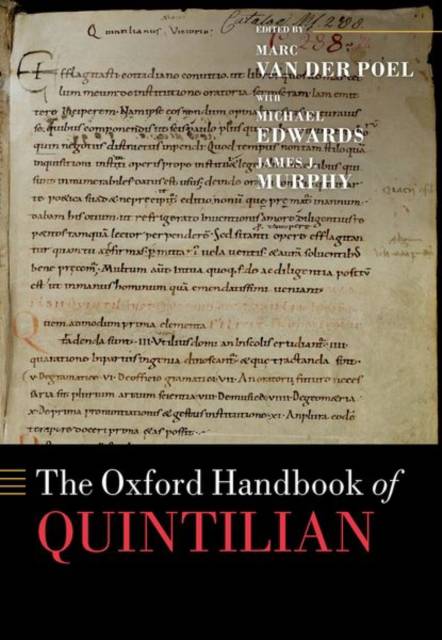
M. Fabius Quintilianus was a prominent orator, declaimer, and teacher of eloquence in the first century CE. After his retirement, he wrote the Institutio oratoria, a unique treatise in antiquity because it is both a handbook of rhetoric and an educational treatise. Quintilian's fame and influence are not only based on the Institutio, but also on the two collections of Declamations which were later attributed to him. The Oxford Handbook of Quintilian aims to present Quintilian's Institutio as a key treatise in the history of Greco-Roman rhetoric and to trace its influence on the theory and practice of rhetoric and education up to the present day. Topics include Quintilian's educational programme, his concepts and classifications of rhetoric, his discussion of the five canons of rhetoric, his style, his views on literary criticism, declamation, and the relationship between rhetoric and law, and the importance of the visual and performing arts in his work. His legacy is presented in successive chapters devoted to Quintilian in late antiquity, the Middle Ages, the Italian Renaissance, Northern Europe during the Renaissance, Europe from the eighteenth to the twentieth century, and the United States of America. Other chapters examine the biographical tradition, the history of printed editions, and modern assessments of Quintilian. The contributors represent a wide range of expertise and scholarly traditions, offering a unique, multidisciplinary perspective.
Specificaties
Betrokkenen
- Auteur(s):
- Uitgeverij:
Inhoud
- Aantal bladzijden:
- 584
- Taal:
- Engels
- Reeks:
Eigenschappen
- Productcode (EAN):
- 9780198713784
- Verschijningsdatum:
- 3/03/2022
- Uitvoering:
- Hardcover
- Formaat:
- Genaaid
- Afmetingen:
- 178 mm x 249 mm
- Gewicht:
- 1202 g


Alleen bij Standaard Boekhandel
+ 676 punten op je klantenkaart van Standaard Boekhandel
CADEAU

AANGERADEN


Beoordelingen
We publiceren alleen reviews die voldoen aan de voorwaarden voor reviews. Bekijk onze voorwaarden voor reviews.