


- Afhalen na 1 uur in een winkel met voorraad
- Gratis thuislevering in België vanaf € 30
- Ruim aanbod met 7 miljoen producten
- Afhalen na 1 uur in een winkel met voorraad
- Gratis thuislevering in België vanaf € 30
- Ruim aanbod met 7 miljoen producten





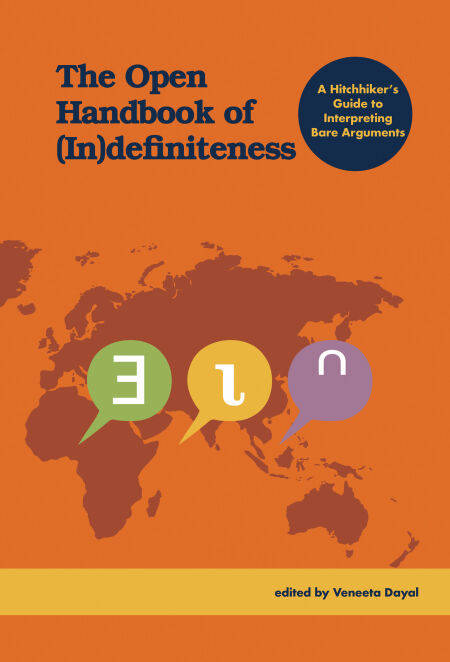
The Open Handbook of (In)definiteness E-BOOK
A Hitchhiker’s Guide to Interpreting Bare Arguments
€ 192,22
+ 192 punten
Uitvoering
Omschrijving
A hands-on, accessible guide for investigating the meaning of noun phrases.
Why do many languages have definite and indefinite articles, while many others do not? What principles govern the use of articles? Do these principles apply to article-less languages? These are some of the questions that confront anyone who engages seriously with language, from theoretical linguists and cognitive scientists to language learners and language teachers. In The Open Handbook of (In)definiteness, Veneeta Dayal clarifies how morpho-syntactic signals related to (in)definiteness can be distinguished from interpretation.
Dayal provides a path for scholars to describe how (in)definiteness plays out in any language by identifying different aspects of definiteness and indefiniteness, providing short introductions to relevant concepts in formal semantics. Explicit diagnostics are collated in the form of a questionnaire. The volume includes case studies that work in tandem with the questionnaire to probe the interpretive profile of seven typologically unrelated languages, revealing new facets of their grammar. The result is both empirically rich and theoretically intriguing, as Dayal elaborates in her discussion of cross-linguistic variation in the domain of nominal semantics. . Contributions by experts of the seven languages investigated showcase some of the avenues that the volume opens for future explorations.
Why do many languages have definite and indefinite articles, while many others do not? What principles govern the use of articles? Do these principles apply to article-less languages? These are some of the questions that confront anyone who engages seriously with language, from theoretical linguists and cognitive scientists to language learners and language teachers. In The Open Handbook of (In)definiteness, Veneeta Dayal clarifies how morpho-syntactic signals related to (in)definiteness can be distinguished from interpretation.
Dayal provides a path for scholars to describe how (in)definiteness plays out in any language by identifying different aspects of definiteness and indefiniteness, providing short introductions to relevant concepts in formal semantics. Explicit diagnostics are collated in the form of a questionnaire. The volume includes case studies that work in tandem with the questionnaire to probe the interpretive profile of seven typologically unrelated languages, revealing new facets of their grammar. The result is both empirically rich and theoretically intriguing, as Dayal elaborates in her discussion of cross-linguistic variation in the domain of nominal semantics. . Contributions by experts of the seven languages investigated showcase some of the avenues that the volume opens for future explorations.
Specificaties
Betrokkenen
- Uitgeverij:
Inhoud
- Aantal bladzijden:
- 448
- Taal:
- Engels
- Reeks:
Eigenschappen
- Productcode (EAN):
- 9780262052818
- Verschijningsdatum:
- 1/06/2026
- Uitvoering:
- E-book
- Beveiligd met:
- Adobe DRM
- Formaat:
- ePub

Alleen bij Standaard Boekhandel
+ 192 punten op je klantenkaart van Standaard Boekhandel
Cadeau

AANGERADEN


Beoordelingen
We publiceren alleen reviews die voldoen aan de voorwaarden voor reviews. Bekijk onze voorwaarden voor reviews.