


- Afhalen na 1 uur in een winkel met voorraad
- Gratis thuislevering in België vanaf € 30
- Ruim aanbod met 7 miljoen producten
- Afhalen na 1 uur in een winkel met voorraad
- Gratis thuislevering in België vanaf € 30
- Ruim aanbod met 7 miljoen producten





€ 21,95
+ 43 punten
Uitvoering
Eenvoudig bestellen
Veilig betalen


Gratis thuislevering vanaf € 30 (via bpost)
Gratis levering in je Standaard Boekhandel
Omschrijving
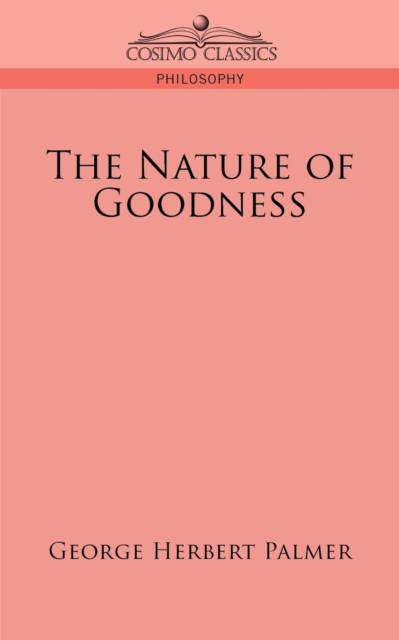
"In undertaking the following discussion I foresee two grave difficulties. My reader may well feel that goodness is already the most familiar of all the thoughts we employ, and yet he may at the same time suspect that there is something about it perplexingly abstruse and remote. Familiar it certainly is. It attends all our wishes, acts, and projects as nothing else does, so that no estimate of its influence can be excessive." -From the Preface The concept of "goodness" is a timeless predicament. Philosophers to modern neuroscientists have yet to decipher the source of man's innate goodness. In fact, George H. Palmer's own constant quest to comprehend and appreciate what made people behave the way they continues to fascinate contemporary fans of philosophy to this day. Originally delivered as a slate of lectures at Harvard, Dartmouth and Wellesley Colleges during the early twentieth century and published in book form in 1903, the core of the essays here include: . The Double Affect of Goodness, . Misconceptions of Goodness, . Self-Consciousness, . Self-Direction, . Self-Development, . Self-Sacrifice, . Nature and Spirit, and, . The Three Stages of Goodness. As a pioneering educator and American philosopher, GEORGE HERBERT PALMER (1842-1933), was educated at Harvard (1864) and Andover Theological Seminary (1870). He became a Greek tutor at Harvard in 1870 and eventually earning the status of professor emeritus and overseer from 1913-1919. Notably, Palmer was the first Harvard lecturer to discard the textbook model of teaching philosophy by using his own philosophical approach in lectures. Other works include The Life and Works of George Herbert (1905), The Field of Ethics (1901), and Altruism: Its Nature and Varieties (1919).
Specificaties
Betrokkenen
- Auteur(s):
- Uitgeverij:
Inhoud
- Aantal bladzijden:
- 264
- Taal:
- Engels
Eigenschappen
- Productcode (EAN):
- 9781596058163
- Verschijningsdatum:
- 1/04/2006
- Uitvoering:
- Paperback
- Formaat:
- Trade paperback (VS)
- Afmetingen:
- 127 mm x 203 mm
- Gewicht:
- 290 g



Alleen bij Standaard Boekhandel
+ 43 punten op je klantenkaart van Standaard Boekhandel
CADEAU

AANGERADEN


Beoordelingen
We publiceren alleen reviews die voldoen aan de voorwaarden voor reviews. Bekijk onze voorwaarden voor reviews.