


- Afhalen na 1 uur in een winkel met voorraad
- Gratis thuislevering in België vanaf € 30
- Ruim aanbod met 7 miljoen producten
- Afhalen na 1 uur in een winkel met voorraad
- Gratis thuislevering in België vanaf € 30
- Ruim aanbod met 7 miljoen producten





Omschrijving
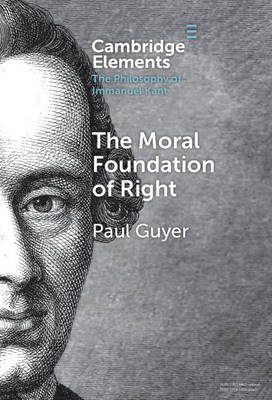
Kant defined 'Right' (Recht) as the condition that obtains among a population of physically embodied persons capable of setting their own ends who live on a finite surface and therefore cannot avoid interaction with each other if each is as free to set their own ends as is consistent with the freedom of all to do the same. He regarded this rational idea, heir to the traditional idea of 'natural Right, as the test of the legitimacy of the laws of any actual state, or 'positive Right.' He clearly considered Right to be part of morality as a whole, namely the coercively enforceable part, as contrasted to Ethics, which is the non-coercively enforceable part of morality. Some have questioned whether Right is part of morality, but this Element shows how Kant's "Universal Principle of Right" follows straightforwardly from the foundational idea of Kant's moral philosophy as a whole.
Specificaties
Betrokkenen
- Auteur(s):
- Uitgeverij:
Inhoud
- Aantal bladzijden:
- 72
- Taal:
- Engels
- Reeks:
Eigenschappen
- Productcode (EAN):
- 9781009464468
- Verschijningsdatum:
- 16/01/2025
- Uitvoering:
- Hardcover
- Formaat:
- Genaaid
- Afmetingen:
- 152 mm x 229 mm
- Gewicht:
- 272 g


Alleen bij Standaard Boekhandel
+ 248 punten op je klantenkaart van Standaard Boekhandel
Cadeau

AANGERADEN


Beoordelingen
We publiceren alleen reviews die voldoen aan de voorwaarden voor reviews. Bekijk onze voorwaarden voor reviews.