


- Afhalen na 1 uur in een winkel met voorraad
- Gratis thuislevering in België vanaf € 30
- Ruim aanbod met 7 miljoen producten
- Afhalen na 1 uur in een winkel met voorraad
- Gratis thuislevering in België vanaf € 30
- Ruim aanbod met 7 miljoen producten





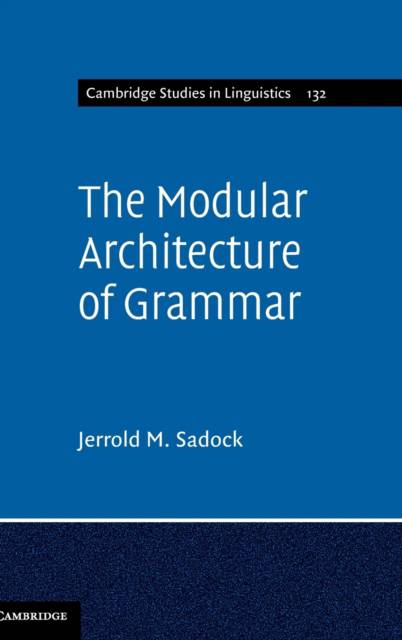
The Modular Architecture of Grammar
Jerrold M Sadock
€ 209,45
+ 418 punten
Omschrijving
Modular grammar postulates several autonomous generative systems interacting with one another as opposed to the prevailing theory of transformational grammar where there is a single generative component - the syntax - from which other representations are derived. In this book Jerrold Sadock develops his influential theory of grammar, formalizing several generative modules that independently characterize the levels of syntax, semantics, role structure, morphology and linear order, as well as an interface system that connects them. Multi-modular grammar provides simpler, more intuitive analyses of grammatical phenomena and allows for greater empirical coverage than prevailing styles of grammar. The book illustrates this with a wide-ranging analysis of English grammatical phenomena, including raising, control, passive, inversion, do-support, auxiliary verbs and ellipsis. The modules are simple enough to be cast as phrase structure grammars and are presented in sufficient detail to make descriptions of grammatical phenomena more explicit than the approximate accounts offered in other studies.
Specificaties
Betrokkenen
- Auteur(s):
- Uitgeverij:
Inhoud
- Aantal bladzijden:
- 282
- Taal:
- Engels
- Reeks:
- Reeksnummer:
- nr. 132
Eigenschappen
- Productcode (EAN):
- 9781107011946
- Verschijningsdatum:
- 12/01/2012
- Uitvoering:
- Hardcover
- Formaat:
- Genaaid
- Afmetingen:
- 152 mm x 229 mm
- Gewicht:
- 589 g


Alleen bij Standaard Boekhandel
+ 418 punten op je klantenkaart van Standaard Boekhandel
Cadeau

AANGERADEN


Beoordelingen
We publiceren alleen reviews die voldoen aan de voorwaarden voor reviews. Bekijk onze voorwaarden voor reviews.