


- Afhalen na 1 uur in een winkel met voorraad
- Gratis thuislevering in België vanaf € 30
- Ruim aanbod met 7 miljoen producten
- Afhalen na 1 uur in een winkel met voorraad
- Gratis thuislevering in België vanaf € 30
- Ruim aanbod met 7 miljoen producten





€ 57,95
+ 115 punten
Eenvoudig bestellen
Veilig betalen


Gratis thuislevering vanaf € 30 (via bpost)
Gratis levering in je Standaard Boekhandel
Omschrijving
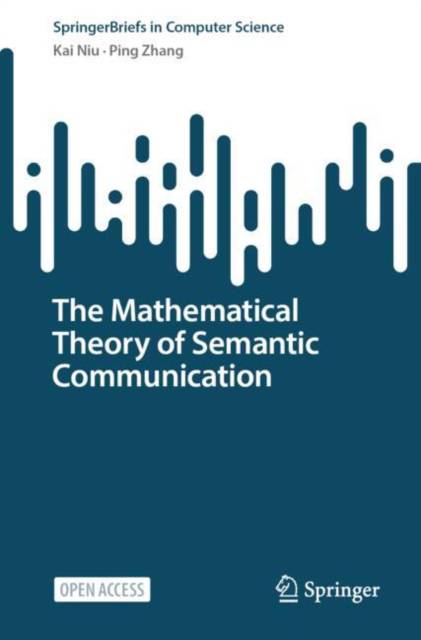
This Open Access Book explores how classical information theory's focus on syntactic information has limited the further development of communication science. Recently, communication technologies that handle and transmit semantic information have gained widespread attention in academia. Semantic communication has paved new directions for the future of communication technology development, yet it lacks a general mathematical guiding theory. To address this challenge, this open access book constructs a theoretical framework for semantic information theory and provides a systematic exposition of the measurement system for semantic information and the theoretical limits of semantic communication. It serves as a professional reference for researchers in information and communication. The book begins by deeply analyzing the data characteristics of various information sources and the needs of downstream tasks to summarize and generalize the universal attribute of semantic information--synonymity and to define the synonymous mapping between semantic information and syntactic information. Stemming from this core concept, synonymous mapping, this book introduces the measures of semantic information. It then introduces a new mathematical tool, Synonymous Asymptotic Equipartition (AEP), to explore the mathematical properties of synonymous typical sequences and applies random coding and synonymous typical sequence decoding/encoding to prove the semantic lossless source coding theorem, semantic channel coding theorem, and semantic limited distortion source coding theorem. In addition, the semantic information measures in the continuous case are discussed and a new channel capacity formula of the band-limited Gaussian channel is obtained, which is an important extension of the classical channel capacity. The book is a valuable resource for researchers, academics, and professionals in the field of information and communication, particularly those interested in advancing the frontiers of semantic communication technology.
Specificaties
Betrokkenen
- Auteur(s):
- Uitgeverij:
Inhoud
- Aantal bladzijden:
- 115
- Taal:
- Engels
- Reeks:
Eigenschappen
- Productcode (EAN):
- 9789819651313
- Verschijningsdatum:
- 1/06/2025
- Uitvoering:
- Paperback
- Formaat:
- Trade paperback (VS)
- Afmetingen:
- 156 mm x 234 mm
- Gewicht:
- 185 g


Alleen bij Standaard Boekhandel
+ 115 punten op je klantenkaart van Standaard Boekhandel
CADEAU

AANGERADEN


Beoordelingen
We publiceren alleen reviews die voldoen aan de voorwaarden voor reviews. Bekijk onze voorwaarden voor reviews.