


- Afhalen na 1 uur in een winkel met voorraad
- Gratis thuislevering in België vanaf € 30
- Ruim aanbod met 7 miljoen producten
- Afhalen na 1 uur in een winkel met voorraad
- Gratis thuislevering in België vanaf € 30
- Ruim aanbod met 7 miljoen producten





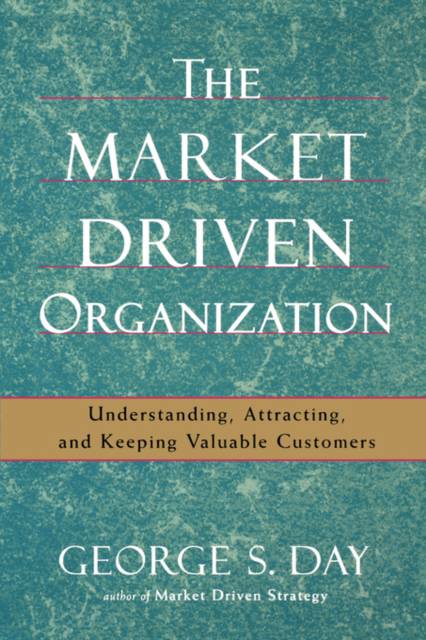
The Market Driven Organization
Understanding, Attracting, and Keeping Valuable Customers
George S Day
Paperback | Engels
€ 31,45
+ 62 punten
Omschrijving
For forty years managers have been exhorted to "stay close to the customer and ahead of the competition." And with good reason Research now shows that market driven organizations outperform their rivals. Given the obvious benefits, why do so many companies fail to become market driven? Because their internal processes, structures, incentives, and controls get in the way, says George Day, one of the world's leading authorities on mar keting Strategy. Building on his pathbreaking book Market Driven Strategy and a decade of experience in coaching firms to deliver superior customer value, Day presents for the first time a battle tested hame work for creating the market-driven organization. In eminently readable prose, Day argues that in successful market driven organizations, three key elements -- capabilities, culture, and configuration -- are aligned to the market. Day explores the distinctive market sensing and market relating capabilities that are at the heart of the market-driven companies. He draws on examples of such market-driven firms as Intuit, Wal-Mart, Virgin Airlines, Disney, and Gillette to illustrate how intimate knowledge of their customers and markets gives these firms a powerful advantage over rivals. By contrast, Day shows how failure to align the organization to the market can result in such mishaps as IBM's loss of leadership of the computer market or Motorola's stumble in shifting from analog to digital cellular phone systems. Using case studies of Owens Corning, Sears, and the Eurotunnel, Day provides a concise roadmap to managers who want to strengthen the orientation of their organizations to the market. He concludes with a detailed diagnostic questionnaire to help managers assess their own progress Here at last are all the insights and tools necessary to construct a company with superior skills for understanding, attracting, and keeping valuable customers.
Specificaties
Betrokkenen
- Auteur(s):
- Uitgeverij:
Inhoud
- Aantal bladzijden:
- 304
- Taal:
- Engels
Eigenschappen
- Productcode (EAN):
- 9781416584612
- Verschijningsdatum:
- 26/10/2007
- Uitvoering:
- Paperback
- Formaat:
- Trade paperback (VS)
- Afmetingen:
- 151 mm x 230 mm
- Gewicht:
- 439 g


Alleen bij Standaard Boekhandel
+ 62 punten op je klantenkaart van Standaard Boekhandel
Cadeau

AANGERADEN


Beoordelingen
We publiceren alleen reviews die voldoen aan de voorwaarden voor reviews. Bekijk onze voorwaarden voor reviews.