


- Afhalen na 1 uur in een winkel met voorraad
- Gratis thuislevering in België vanaf € 30
- Ruim aanbod met 7 miljoen producten
- Afhalen na 1 uur in een winkel met voorraad
- Gratis thuislevering in België vanaf € 30
- Ruim aanbod met 7 miljoen producten




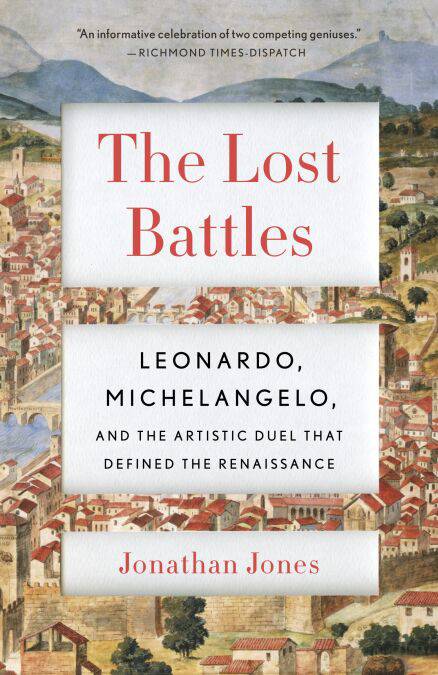
The Lost Battles E-BOOK
Leonardo, Michelangelo, and the Artistic Duel That Defined the Renaissance
Jonathan Jones
E-book | Engels
€ 10,40
+ 10 punten
Uitvoering
Eenvoudig bestellen
Veilig betalen


Onmiddellijk geleverd via e-mail
Omschrijving
From one of Britain’s most respected and acclaimed art historians, art critic of The Guardian—the galvanizing story of a sixteenth-century clash of titans, the two greatest minds of the Renaissance, working side by side in the same room in a fierce competition: the master Leonardo da Vinci, commissioned by the Florentine Republic to paint a narrative fresco depicting a famous military victory on a wall of the newly built Great Council Hall in the Palazzo Vecchio, and his implacable young rival, the thirty-year-old Michelangelo.
We see Leonardo, having just completed The Last Supper, and being celebrated by all of Florence for his miraculous portrait of the wife of a textile manufacturer. That painting—the Mona Lisa—being called the most lifelike anyone had ever seen yet, more divine than human, was captivating the entire Florentine Republic.
And Michelangelo, completing a commissioned statue of David, the first colossus of the Renaissance, the archetype hero for the Republic epitomizing the triumph of the weak over the strong, helping to reshape the public identity of the city of Florence and conquer its heart.
In The Lost Battles, published in England to great acclaim (“Superb”—The Observer; “Beguilingly written”—The Guardian), Jonathan Jones brilliantly sets the scene of the time—the politics; the world of art and artisans; and the shifting, agitated cultural landscape.
We see Florence, a city freed from the oppressive reach of the Medicis, lurching from one crisis to another, trying to protect its liberty in an Italy descending into chaos, with the new head of the Republic in search of a metaphor that will make clear the glory that is Florence, and seeing in the commissioned paintings the expression of his vision.
Jones reconstructs the paintings that Leonardo and Michelangelo undertook—Leonardo’s Battle of Anghiari, a nightmare seen in the eyes of the warrior (it became the first modern depiction of the disenchantment of war) and Michelangelo’s Battle of Cascina, a call to arms and the first great transfiguration of the erotic into art. Jones writes about the competition; how it unfolded and became the defining moment in the transformation of “craftsman” to “artist”; why the Florentine government began to fall out of love with one artist in favor of the other; and how—and why—in a competition that had no formal prize to clearly resolve the outcome, the battle became one for the hearts and minds of the Florentine Republic, with Michelangelo setting out to prove that his work, not Leonardo’s, embodied the future of art. Finally, we see how the result of the competition went on to shape a generation of narrative paintings, beginning with those of Raphael.
A riveting exploration into one of history’s most resonant exchanges of ideas, a rich, fascinating book that gives us a whole new understanding of an age and those at its center.
We see Leonardo, having just completed The Last Supper, and being celebrated by all of Florence for his miraculous portrait of the wife of a textile manufacturer. That painting—the Mona Lisa—being called the most lifelike anyone had ever seen yet, more divine than human, was captivating the entire Florentine Republic.
And Michelangelo, completing a commissioned statue of David, the first colossus of the Renaissance, the archetype hero for the Republic epitomizing the triumph of the weak over the strong, helping to reshape the public identity of the city of Florence and conquer its heart.
In The Lost Battles, published in England to great acclaim (“Superb”—The Observer; “Beguilingly written”—The Guardian), Jonathan Jones brilliantly sets the scene of the time—the politics; the world of art and artisans; and the shifting, agitated cultural landscape.
We see Florence, a city freed from the oppressive reach of the Medicis, lurching from one crisis to another, trying to protect its liberty in an Italy descending into chaos, with the new head of the Republic in search of a metaphor that will make clear the glory that is Florence, and seeing in the commissioned paintings the expression of his vision.
Jones reconstructs the paintings that Leonardo and Michelangelo undertook—Leonardo’s Battle of Anghiari, a nightmare seen in the eyes of the warrior (it became the first modern depiction of the disenchantment of war) and Michelangelo’s Battle of Cascina, a call to arms and the first great transfiguration of the erotic into art. Jones writes about the competition; how it unfolded and became the defining moment in the transformation of “craftsman” to “artist”; why the Florentine government began to fall out of love with one artist in favor of the other; and how—and why—in a competition that had no formal prize to clearly resolve the outcome, the battle became one for the hearts and minds of the Florentine Republic, with Michelangelo setting out to prove that his work, not Leonardo’s, embodied the future of art. Finally, we see how the result of the competition went on to shape a generation of narrative paintings, beginning with those of Raphael.
A riveting exploration into one of history’s most resonant exchanges of ideas, a rich, fascinating book that gives us a whole new understanding of an age and those at its center.
Specificaties
Betrokkenen
- Auteur(s):
- Uitgeverij:
Inhoud
- Aantal bladzijden:
- 368
- Taal:
- Engels
Eigenschappen
- Productcode (EAN):
- 9780307961013
- Verschijningsdatum:
- 22/10/2012
- Uitvoering:
- E-book
- Beveiligd met:
- Adobe DRM
- Formaat:
- ePub


Alleen bij Standaard Boekhandel
+ 10 punten op je klantenkaart van Standaard Boekhandel
CADEAU

AANGERADEN


Beoordelingen
We publiceren alleen reviews die voldoen aan de voorwaarden voor reviews. Bekijk onze voorwaarden voor reviews.