



- Afhalen na 1 uur in een winkel met voorraad
- In januari gratis thuislevering in België
- Ruim aanbod met 7 miljoen producten
- Afhalen na 1 uur in een winkel met voorraad
- In januari gratis thuislevering in België
- Ruim aanbod met 7 miljoen producten





€ 43,45
+ 86 punten
Omschrijving
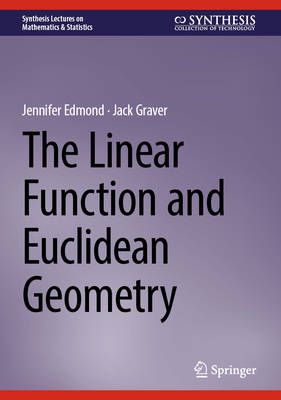
This book is intended as a bridge between high school and college mathematics. The contents have been chosen to demonstrate the relationships among topics from the high school curriculum, including topics that may be part of a fourth year non-calculus mathematics course and first and second year college courses. As the title indicates, the common thread of this work is the linear function. The two parts of the book are devoted, in turn, to: the linear function of a real variable and the linear function of a 2-dimensional vector variable. A second common thread is the visualization of these functions as transformations of 1- or 2-dimensional Euclidean space. The topics, examples, and problems have all been chosen to encourage the integration of the major topics from the high school curriculum. Another feature of this book is that it includes proofs. Specifically, not the formal "two column proofs" often included in the study of geometry in high school, but the more informal, but nevertheless rigorous, step-by-step explanations of why what we believe to be true is indeed true. One of the common complaints of the colleges is that a large majority of incoming freshmen do not have algebra as a usable tool. In this book, algebra is seen to be an essential tool for the further study of mathematics. Algebraic skills are strengthened by constantly using algebra and by seeing the application of algebra in a variety of settings.
Specificaties
Betrokkenen
- Auteur(s):
- Uitgeverij:
Inhoud
- Aantal bladzijden:
- 160
- Taal:
- Engels
- Reeks:
Eigenschappen
- Productcode (EAN):
- 9783032227119
- Verschijningsdatum:
- 25/05/2026
- Uitvoering:
- Hardcover
- Formaat:
- Genaaid
- Afmetingen:
- 168 mm x 240 mm


Alleen bij Standaard Boekhandel
+ 86 punten op je klantenkaart van Standaard Boekhandel
Cadeau

AANGERADEN


Beoordelingen
We publiceren alleen reviews die voldoen aan de voorwaarden voor reviews. Bekijk onze voorwaarden voor reviews.