


- Afhalen na 1 uur in een winkel met voorraad
- Gratis thuislevering in België vanaf € 30
- Ruim aanbod met 7 miljoen producten
- Afhalen na 1 uur in een winkel met voorraad
- Gratis thuislevering in België vanaf € 30
- Ruim aanbod met 7 miljoen producten





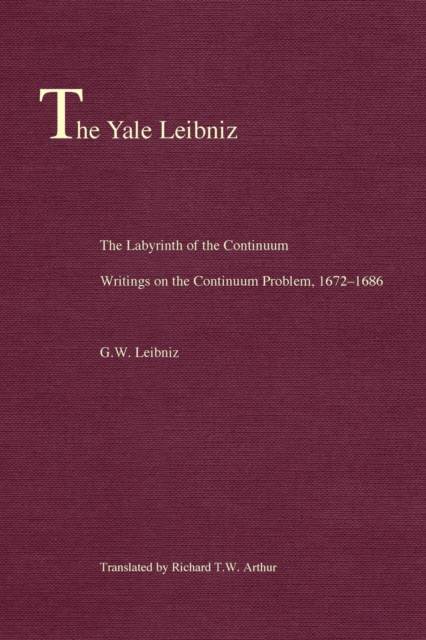
The Labyrinth of the Continuum
Writings on the Continuum Problem, 1672-1686
Gottfried Wilhelm Leibniz
€ 60,45
+ 120 punten
Eenvoudig bestellen
Veilig betalen


Gratis thuislevering vanaf € 30 (via bpost)
Gratis levering in je Standaard Boekhandel
Omschrijving
This book gathers together for the first time an important body of texts written between 1672 and 1686 by the great German philosopher and polymath Gottfried Leibniz. These writings, most of them previously untranslated, represent Leibniz's sustained attempt on a problem whose solution was crucial to the development of his thought, that of the composition of the continuum. The volume begins with excerpts from Leibniz's Paris writings, in which he tackles such problems as whether the infinite division of matter entails "perfect points," whether matter and space can be regarded as true wholes, whether motion is truly continuous, and the nature of body and substance. Comprising the second section is Pacidius Philalethi, Leibniz's brilliant dialogue of late 1676 on the problem of the continuity of motion. In the selections of the final section, from his Hanover writings of 1677-1686, Leibniz abandons his earlier transcreationism and atomism in favor of the theory of corporeal substance, where the reality of body and motion is founded in substantial form or force. Leibniz's texts (one in French, the rest in Latin) are presented with facing-page English translations, together with an introduction, notes, appendixes containing related excerpts from earlier works by Leibniz and his predecessors, and a valuable glossary detailing important terms and their translations.
Specificaties
Betrokkenen
- Auteur(s):
- Vertaler(s):
- Uitgeverij:
Inhoud
- Aantal bladzijden:
- 484
- Taal:
- Engels
- Reeks:
Eigenschappen
- Productcode (EAN):
- 9780300205053
- Verschijningsdatum:
- 30/08/2013
- Uitvoering:
- Paperback
- Formaat:
- Trade paperback (VS)
- Afmetingen:
- 156 mm x 234 mm
- Gewicht:
- 870 g


Alleen bij Standaard Boekhandel
+ 120 punten op je klantenkaart van Standaard Boekhandel
CADEAU

AANGERADEN


Beoordelingen
We publiceren alleen reviews die voldoen aan de voorwaarden voor reviews. Bekijk onze voorwaarden voor reviews.