


- Afhalen na 1 uur in een winkel met voorraad
- Gratis thuislevering in België vanaf € 30
- Ruim aanbod met 7 miljoen producten
- Afhalen na 1 uur in een winkel met voorraad
- Gratis thuislevering in België vanaf € 30
- Ruim aanbod met 7 miljoen producten





€ 3,49
+ 3 punten
Eenvoudig bestellen
Veilig betalen


Onmiddellijk geleverd via e-mail
Omschrijving
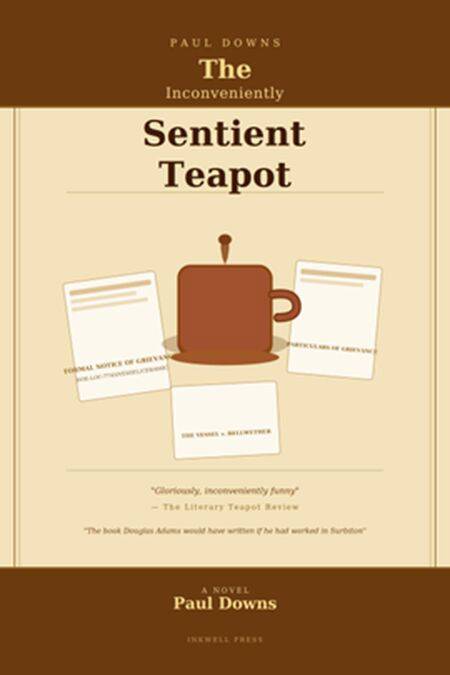
What happens when your kitchen objects have had enough?
Edwin Bellwether is thirty-four years old, five feet ten inches tall, and has been the most statistically average man in Britain for eleven consecutive years. He processes Form 27B/6s at the Ministry of Statistical Inevitability. He eats on a rotation of forty-two meals. He has never, in eleven years of daily use, wondered what his teapot thinks of him.
He should have wondered.
Gerald — as the teapot has called himself for seven years, without Edwin's knowledge — has had enough. Citing five formal grievances including repeated thermal deployment without consent, chip-related negligence, and a persistent failure to acknowledge Gerald's existence as a sentient entity, the teapot files a legal complaint with the Department of Overlooked Entities and retains the services of Ms. Perdita Clause LLB, a barrister who specialises in the representation of overlooked entities and who bills by the paradox.
Edwin, who has spent thirty-four years being perfectly average, is about to be required to be more present in his life. Considerably more present. And his kitchen has opinions about whether he's managing it.
What follows is part legal drama, part philosophical inquiry, part very gentle horror story about the objects silently judging us from our kitchen surfaces — and entirely a novel about what happens when we stop paying attention to the things that have been paying attention to us.
Join Edwin, Gerald the teapot, Graham the philosophically inclined toaster, Petra the recently named kettle, a drawer with a personality rather than a malfunction, an organisation of eleven million missing socks with a political agenda, and one increasingly invested narrator as they navigate the Overlooked Entities Act 2017, the Department's Ceiling of Acknowledged Grievances (47,283 laminated forms and counting), and the very particular experience of being seen for the first time.
The Inconveniently Sentient Teapot is a novel in the tradition of Douglas Adams, Tom Holt, and Jasper Fforde: absurdist, precise, warm, and rather more moving than it has any right to be. It is a book about attention, and about what we owe to the things and people we share our lives with — even when those things are capable of suing us.
PRAISE FOR THE INCONVENIENTLY SENTIENT TEAPOT: "The book Douglas Adams would have written if he'd worked in Surbiton" | "Gloriously, inconveniently funny" | "A small masterpiece of British absurdism — precise, warm, and genuinely original" | "The funniest novel I have read about bureaucracy, sentience, and tea"
For readers of: Douglas Adams, Tom Holt, Jasper Fforde, Caimh McDonnell, Terry Pratchett, Ben Aaronovitch
Specificaties
Betrokkenen
- Auteur(s):
- Uitgeverij:
Inhoud
- Taal:
- Engels
Eigenschappen
- Productcode (EAN):
- 9798235182806
- Verschijningsdatum:
- 5/05/2026
- Uitvoering:
- E-book
- Formaat:
- ePub


Alleen bij Standaard Boekhandel
+ 3 punten op je klantenkaart van Standaard Boekhandel
CADEAU

AANGERADEN


Beoordelingen
We publiceren alleen reviews die voldoen aan de voorwaarden voor reviews. Bekijk onze voorwaarden voor reviews.