


- Afhalen na 1 uur in een winkel met voorraad
- Gratis thuislevering in België vanaf € 30
- Ruim aanbod met 7 miljoen producten
- Afhalen na 1 uur in een winkel met voorraad
- Gratis thuislevering in België vanaf € 30
- Ruim aanbod met 7 miljoen producten





€ 27,45
+ 54 punten
Uitvoering
Eenvoudig bestellen
Veilig betalen


Gratis thuislevering vanaf € 30 (via bpost)
Gratis levering in je Standaard Boekhandel
Omschrijving
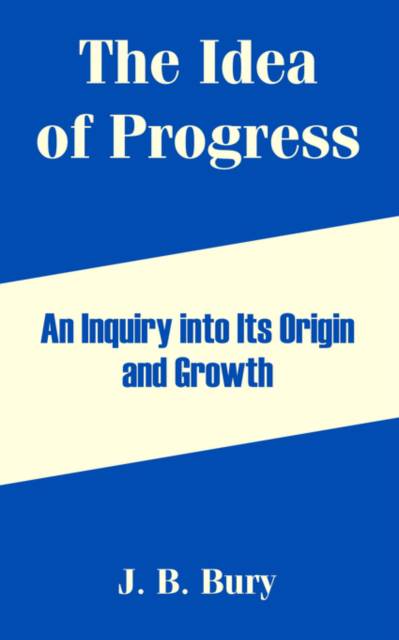
Practically unknown before the Reformation, the idea of progress has since become one of the central concepts of western civilization. Professor Bury analyzes its evolution in the thought of Greece, Rome, the Middle Ages, the Renaissance, to its flowering in all branches of science, religion, philosophy, industry, art, and literature during and following the 16th century. Emphasizing the necessity of adhering with rigid exactness to historical facts, the author presents a scheme of ideas upon which to thread the facts of human development which extends to cover the whole range of civilization in its movement through time. In this classic, oft cited volume, Bury writes a form of intellectual history, tracing the development of the idea of progress from the Greeks through its relationship to the idea of evolution. At the time of original publication in 1921, J. B. Bury was Regius Professor of Modern History, and Fellow of King's College, in the University of Cambridge, and was a profound scholar and a philosophic thinker.
Specificaties
Betrokkenen
- Auteur(s):
- Uitgeverij:
Inhoud
- Aantal bladzijden:
- 396
- Taal:
- Engels
Eigenschappen
- Productcode (EAN):
- 9781410212917
- Verschijningsdatum:
- 10/04/2004
- Uitvoering:
- Paperback
- Formaat:
- Trade paperback (VS)
- Afmetingen:
- 130 mm x 204 mm
- Gewicht:
- 435 g



Alleen bij Standaard Boekhandel
+ 54 punten op je klantenkaart van Standaard Boekhandel
CADEAU

AANGERADEN


Beoordelingen
We publiceren alleen reviews die voldoen aan de voorwaarden voor reviews. Bekijk onze voorwaarden voor reviews.