


- Afhalen na 1 uur in een winkel met voorraad
- Gratis thuislevering in België vanaf € 30
- Ruim aanbod met 7 miljoen producten
- Afhalen na 1 uur in een winkel met voorraad
- Gratis thuislevering in België vanaf € 30
- Ruim aanbod met 7 miljoen producten





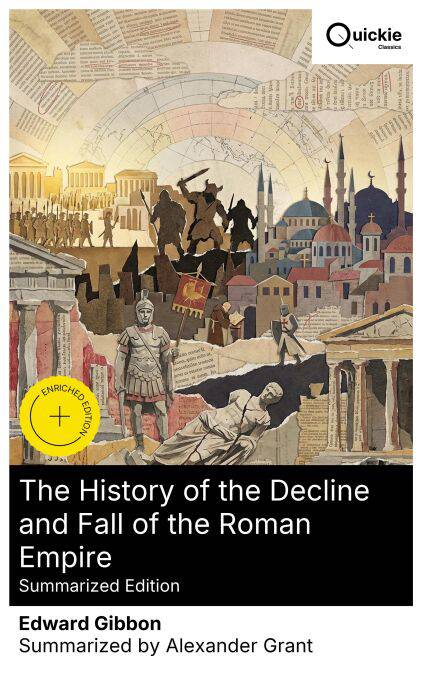
The History of the Decline and Fall of the Roman Empire (Summarized Edition) E-BOOK
Enriched edition. A Panoramic History of Rome and Byzantium, from the Antonines to the Fall of Constantinople
Edward Gibbon
E-book | Engels
€ 1,99
+ 1 punten
Uitvoering
Omschrijving
The complete six-volume Decline and Fall follows the Roman world from the Antonines to the 1453 fall of Constantinople, charting the slow erosion of institutions under internal weakness and external pressure. Gibbon unites panoramic narrative with exacting citation, probing Latin, Greek, and ecclesiastical sources in pointed footnotes. His ironic, periodic prose—an Enlightenment blend of learning and skepticism—treats military discipline, fiscal strain, religious change, and barbarian settlement; set pieces on Justinian and Belisarius, the rise of Islam, and the Crusades punctuate a sustained analysis of structural transformation. Edward Gibbon (1737–1794), an English historian and parliamentarian, conceived the project in 1764 on Rome's Capitoline Hill, where ritual amid ruins sharpened his purpose. Educated in Lausanne and influenced by Montesquieu, he fused classical models with modern criticism. Militia service and parliamentary work honed his eye for administration, finance, and civic virtue—preoccupations that guide his account of imperial resilience and decay. This complete edition rewards readers seeking a grand narrative joined to primary-source critique. Essential for students of late antiquity and Byzantium—and valuable to political theorists—it offers enduring arguments and style. Approach it as history, literature, and provocation; it remains a foundational, debate-sparking companion to the study of power over time.
Quickie Classics summarizes timeless works with precision, preserving the author's voice and keeping the prose clear, fast, and readable—distilled, never diluted. Enriched Edition extras: Introduction · Synopsis · Historical Context · Author Biography · Brief Analysis · 4 Reflection Q&As · Editorial Footnotes.
Quickie Classics summarizes timeless works with precision, preserving the author's voice and keeping the prose clear, fast, and readable—distilled, never diluted. Enriched Edition extras: Introduction · Synopsis · Historical Context · Author Biography · Brief Analysis · 4 Reflection Q&As · Editorial Footnotes.
Specificaties
Betrokkenen
- Auteur(s):
- Uitgeverij:
Inhoud
- Aantal bladzijden:
- 1134
- Taal:
- Engels
Eigenschappen
- Productcode (EAN):
- 8596547877325
- Verschijningsdatum:
- 9/01/2026
- Uitvoering:
- E-book
- Beveiligd met:
- Digital watermarking
- Formaat:
- ePub


Alleen bij Standaard Boekhandel
+ 1 punten op je klantenkaart van Standaard Boekhandel
CADEAU

AANGERADEN


Beoordelingen
We publiceren alleen reviews die voldoen aan de voorwaarden voor reviews. Bekijk onze voorwaarden voor reviews.