


- Afhalen na 1 uur in een winkel met voorraad
- Gratis thuislevering in België vanaf € 30
- Ruim aanbod met 7 miljoen producten
- Afhalen na 1 uur in een winkel met voorraad
- Gratis thuislevering in België vanaf € 30
- Ruim aanbod met 7 miljoen producten





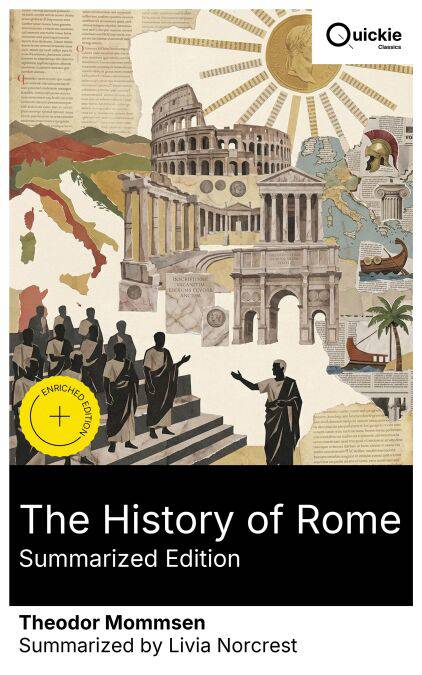
The History of Rome (Summarized Edition) E-BOOK
Enriched edition. A Meticulous, Engaging Study of Ancient Rome's Politics, Culture, and the Rise of Empire
Theodor Mommsen
E-book | Engels
€ 1,99
+ 1 punten
Uitvoering
Eenvoudig bestellen
Veilig betalen


Onmiddellijk geleverd via e-mail
Omschrijving
The History of Rome (Volumes 1–5) surveys Rome from legendary beginnings to the reorganized provinces of the early Empire. Volumes I–III trace the Republic's institutions, Italian expansion, and the crises of Gracchi, Marius, Sulla, Pompey, and Caesar; IV–V anatomize provincial administration, fiscal regimes, and regional societies from Gaul to Syria up to Diocletian. With philological rigor and brisk, lapidary prose, Mommsen marries constitutional analysis to vivid portraits, an interpretive history poised between Rankean method and political argument. Jurist, epigrapher, and parliamentarian, Theodor Mommsen co‑founded the Corpus Inscriptionum Latinarum; his command of inscriptions, law, and numismatics grounds every page. Shaped by 1848 liberalism and Prussian nation‑building, he read the late Republic as a failure of oligarchic institutions requiring decisive reform—hence his famous, contested admiration for Caesar. Awarded the 1902 Nobel Prize in Literature for this work, he wrote as a scholar‑citizen, aligning erudition with civic purpose. For readers of classical history, political theory, or imperial studies, this set remains indispensable: a bracing synthesis, methodologically exact yet passionately argued, that illuminates institutions, economies, and provincial life while provoking debate about power, citizenship, and statecraft.
Quickie Classics summarizes timeless works with precision, preserving the author's voice and keeping the prose clear, fast, and readable—distilled, never diluted. Enriched Edition extras: Introduction · Synopsis · Historical Context · Author Biography · Brief Analysis · 4 Reflection Q&As · Editorial Footnotes.
Quickie Classics summarizes timeless works with precision, preserving the author's voice and keeping the prose clear, fast, and readable—distilled, never diluted. Enriched Edition extras: Introduction · Synopsis · Historical Context · Author Biography · Brief Analysis · 4 Reflection Q&As · Editorial Footnotes.
Specificaties
Betrokkenen
- Auteur(s):
- Vertaler(s):
- Uitgeverij:
Inhoud
- Aantal bladzijden:
- 644
- Taal:
- Engels
Eigenschappen
- Productcode (EAN):
- 8596547880189
- Verschijningsdatum:
- 9/01/2026
- Uitvoering:
- E-book
- Beveiligd met:
- Digital watermarking
- Formaat:
- ePub


Alleen bij Standaard Boekhandel
+ 1 punten op je klantenkaart van Standaard Boekhandel
CADEAU

AANGERADEN


Beoordelingen
We publiceren alleen reviews die voldoen aan de voorwaarden voor reviews. Bekijk onze voorwaarden voor reviews.