


- Afhalen na 1 uur in een winkel met voorraad
- Gratis thuislevering in België vanaf € 30
- Ruim aanbod met 7 miljoen producten
- Afhalen na 1 uur in een winkel met voorraad
- Gratis thuislevering in België vanaf € 30
- Ruim aanbod met 7 miljoen producten





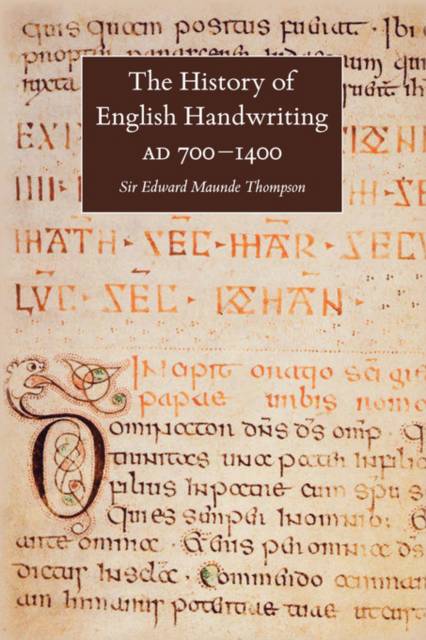
The History of English Handwriting Ad 700-1400
E M Thompson, Edward Maunde Thompson
Paperback | Engels
€ 22,45
+ 44 punten
Omschrijving
Thompson's History of English Handwriting charts the development of the distinctive, and often very beautiful, English scripts, beginning with the introduction of half uncials by Irish monks in the seventh century. Although manuscripts from Rome and elsewhere on the Continent influenced English handwriting, it displayed unique characteristics which even the Norman Conquest did not completely obliterate. The basis of this book is a paper delivered to the Bibliographical Society in 1899 and printed in the Society's Transactions the following year. It has been revised by Gerrish Gray who has taken the opportunity to increase the number of illustrations from eighteen to forty-eight. Transcriptions have been added to eight of these, making the book a useful introduction to English palaeography. Sources of illustrations include Bibles, psalters, chronicles, charters and literary manuscripts. Sir Edward Maunde Thompson (1840-1929) was educated at Rugby and University College, Oxford. Lack of money forced him to leave the University without taking a degree, and in 1861 he found employment at the British Museum as assistant to Sir Anthony Panizzi, the Principal Librarian. He transferred to the Department of Manuscripts in 1862, being made Assistant Keeper in 1871. He was made Keeper of Manuscripts in 1878 and Principal Librarian in 1888. His highly-regarded Introduction to Greek and Latin Palæography was first published in 1893 and revised in 1912.
Specificaties
Betrokkenen
- Auteur(s):
- Uitgeverij:
Inhoud
- Aantal bladzijden:
- 80
- Taal:
- Engels
Eigenschappen
- Productcode (EAN):
- 9781904799108
- Verschijningsdatum:
- 12/03/2008
- Uitvoering:
- Paperback
- Formaat:
- Trade paperback (VS)
- Afmetingen:
- 156 mm x 234 mm
- Gewicht:
- 122 g


Alleen bij Standaard Boekhandel
+ 44 punten op je klantenkaart van Standaard Boekhandel
Cadeau

AANGERADEN


Beoordelingen
We publiceren alleen reviews die voldoen aan de voorwaarden voor reviews. Bekijk onze voorwaarden voor reviews.