


- Afhalen na 1 uur in een winkel met voorraad
- Gratis thuislevering in België vanaf € 30
- Ruim aanbod met 7 miljoen producten
- Afhalen na 1 uur in een winkel met voorraad
- Gratis thuislevering in België vanaf € 30
- Ruim aanbod met 7 miljoen producten





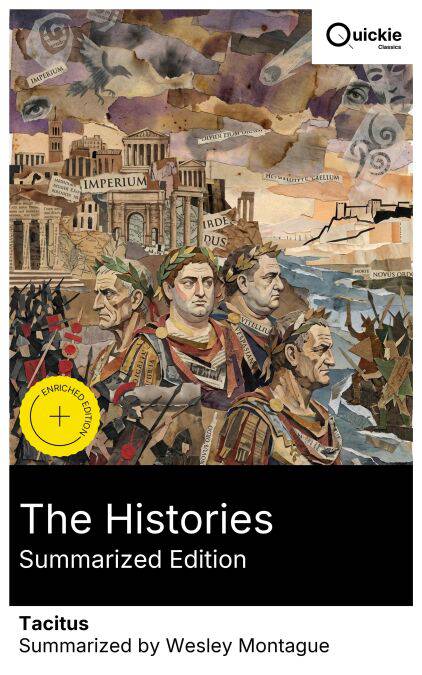
The Histories (Summarized Edition) E-BOOK
Enriched edition. Flavian Dynasty ascendant in first-century Rome: political intrigue, power struggles, military campaigns, and a society in crisis
Tacitus
E-book | Engels
€ 1,99
+ 1 punten
Omschrijving
The Histories chronicles the upheavals of 69–70 CE, the Year of the Four Emperors, as Galba, Otho, Vitellius, and Vespasian vie for the principate. In four surviving books and a fragment of a fifth, Tacitus traces provincial armies' leverage, the Batavian revolt under Civilis, and the early Judaean campaign, framed by a sharp ethnography of the Jews. Rapid annalistic narration alternates with speeches, portents, and caustic portraits; the compressed, ironic Silver Latin recalls Sallust while surpassing him in tragic intensity. Publius Cornelius Tacitus, a senator hardened by Domitian's reign and consul under Nerva, writes with an insider's access and a survivor's moral urgency. Marriage into Agricola's family, administrative service, and rigorous rhetorical training furnished sources and method. Composed in the early second century, after Agricola and Germania and before the Annals, the work inaugurates his sustained critique of autocracy and civil war. Essential for students of Roman history, political thought, and civil–military relations, The Histories rewards both specialists and general readers. Its unsparing analysis of legitimacy, propaganda, and chance illuminates any age in crisis; in an authoritative translation, it is an indispensable companion to understanding how empires fracture and refashion themselves.
Quickie Classics summarizes timeless works with precision, preserving the author's voice and keeping the prose clear, fast, and readable—distilled, never diluted. Enriched Edition extras: Introduction · Synopsis · Historical Context · Author Biography · Brief Analysis · 4 Reflection Q&As · Editorial Footnotes.
Quickie Classics summarizes timeless works with precision, preserving the author's voice and keeping the prose clear, fast, and readable—distilled, never diluted. Enriched Edition extras: Introduction · Synopsis · Historical Context · Author Biography · Brief Analysis · 4 Reflection Q&As · Editorial Footnotes.
Specificaties
Betrokkenen
- Auteur(s):
- Vertaler(s):
- Uitgeverij:
Inhoud
- Aantal bladzijden:
- 141
- Taal:
- Engels
Eigenschappen
- Productcode (EAN):
- 8596547882602
- Verschijningsdatum:
- 9/01/2026
- Uitvoering:
- E-book
- Beveiligd met:
- Digital watermarking
- Formaat:
- ePub


Alleen bij Standaard Boekhandel
+ 1 punten op je klantenkaart van Standaard Boekhandel
Cadeau

AANGERADEN


Beoordelingen
We publiceren alleen reviews die voldoen aan de voorwaarden voor reviews. Bekijk onze voorwaarden voor reviews.