


- Afhalen na 1 uur in een winkel met voorraad
- Gratis thuislevering in België vanaf € 30
- Ruim aanbod met 7 miljoen producten
- Afhalen na 1 uur in een winkel met voorraad
- Gratis thuislevering in België vanaf € 30
- Ruim aanbod met 7 miljoen producten




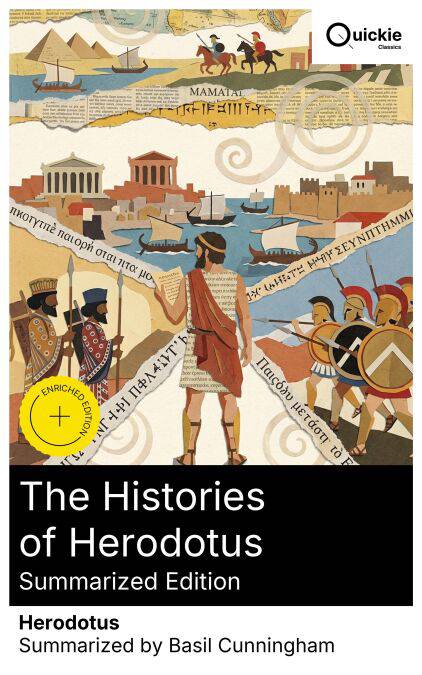
The Histories of Herodotus (Summarized Edition) E-BOOK
Enriched edition. Ancient Greek history and the Greco-Persian Wars through myth, travel, and cultural inquiry in the fifth century BCE
Herodotus
E-book | Engels
€ 1,99
+ 1 punten
Omschrijving
The Histories of Herodotus recounts the origins and course of the Greco-Persian Wars while ranging to Egypt, Lydia, Scythia, and beyond. Written in Ionic Greek, its episodic logoi, speeches, and ring composition bind inquiry (historia) to storytelling, balancing autopsy with reported tales and source critique. Herodotus probes causes—human motives, political institutions, and divine retribution—testing boundaries between myth and reason in a fifth‑century culture of public recitation and emergent history. Born in Halicarnassus under Persian sway, Herodotus traveled widely, consulting priests, interpreters, and monuments; time in Athens and Thurii sharpened his panhellenic vantage. His proem vows to preserve great deeds from oblivion and to explain the war's aitiai; Homeric poetics, Ionian inquiry, and civic debate shape his method. Praised by Cicero and rebuked by Thucydides, he remains a self‑aware investigator who flags uncertainty. Readers of classics, history, political thought, and anthropology will find a model of narrative analysis and cross‑cultural curiosity. Treat the digressions as experiments in comparison and the speeches as laboratories of reasoning; they teach how to weigh testimony and infer causes. For anyone seeking the earliest sustained Western meditation on why events happen—and how we can know—The Histories is both an archive of wonders and an indispensable argument.
Quickie Classics summarizes timeless works with precision, preserving the author's voice and keeping the prose clear, fast, and readable—distilled, never diluted. Enriched Edition extras: Introduction · Synopsis · Historical Context · Author Biography · Brief Analysis · 4 Reflection Q&As · Editorial Footnotes.
Quickie Classics summarizes timeless works with precision, preserving the author's voice and keeping the prose clear, fast, and readable—distilled, never diluted. Enriched Edition extras: Introduction · Synopsis · Historical Context · Author Biography · Brief Analysis · 4 Reflection Q&As · Editorial Footnotes.
Specificaties
Betrokkenen
- Auteur(s):
- Vertaler(s):
- Uitgeverij:
Inhoud
- Aantal bladzijden:
- 239
- Taal:
- Engels
Eigenschappen
- Productcode (EAN):
- 8596547880295
- Verschijningsdatum:
- 09/01/2026
- Uitvoering:
- E-book
- Beveiligd met:
- Digital watermarking
- Formaat:
- ePub


Alleen bij Standaard Boekhandel
+ 1 punten op je klantenkaart van Standaard Boekhandel
AANGERADEN


Beoordelingen
We publiceren alleen reviews die voldoen aan de voorwaarden voor reviews. Bekijk onze voorwaarden voor reviews.