


- Afhalen na 1 uur in een winkel met voorraad
- Gratis thuislevering in België vanaf € 30
- Ruim aanbod met 7 miljoen producten
- Afhalen na 1 uur in een winkel met voorraad
- Gratis thuislevering in België vanaf € 30
- Ruim aanbod met 7 miljoen producten





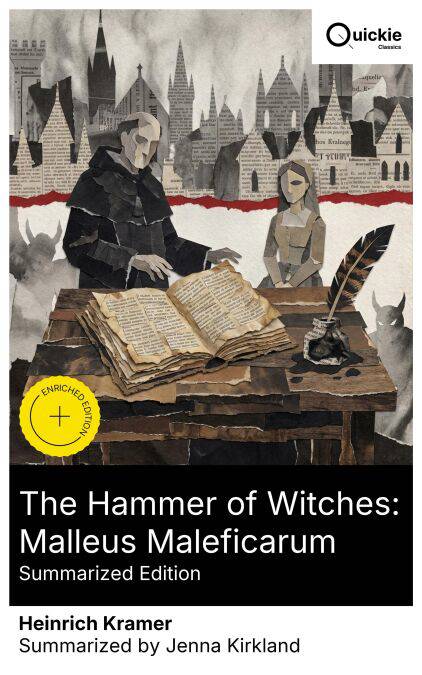
The Hammer of Witches: Malleus Maleficarum (Summarized Edition) E-BOOK
Enriched edition. Witchcraft Trials, Demonology, and Medieval Superstition in the Inquisition Era: A 15th-Century Study of Persecution
Heinrich Kramer
E-book | Engels
€ 1,99
+ 1 punten
Eenvoudig bestellen
Veilig betalen


Onmiddellijk geleverd via e-mail
Omschrijving
The Hammer of Witches (Malleus Maleficarum, 1486/7) is the most notorious manual of demonology and witch prosecution in late medieval Christendom. Cast in scholastic quaestio form, it proceeds in three parts: asserting the reality of witchcraft and diabolic pacts; cataloguing maleficia, illusions, and the alleged weaknesses of women; and prescribing inquisitorial and judicial procedure. Kramer piles authorities—Scripture, Augustine, Aquinas, Gratian—and invokes Innocent VIII's Summis desiderantes. Polemical yet juridical, it fuses theology, folklore, and canon law at the dawn of print culture. Heinrich Kramer (Institoris), a Dominican inquisitor in the German lands, wrote the treatise after setbacks at Innsbruck in 1485, when the Bishop of Brixen halted his case against Helena Scheuberin; the book defends his methods as much as it instructs judges. Trained in Thomism and inquisitorial procedure, he fused pastoral zeal with misogynistic anthropology. Though Jacob Sprenger is named, scholars largely credit Kramer alone. Read critically, this work is indispensable for students of religion, law, gender, and early modernity, revealing how doctrine became policy and persecution. I recommend consulting a modern critical edition to contextualize its claims and confront its damaging legacy.
Quickie Classics summarizes timeless works with precision, preserving the author's voice and keeping the prose clear, fast, and readable—distilled, never diluted. Enriched Edition extras: Introduction · Synopsis · Historical Context · Brief Analysis · 4 Reflection Q&As · Editorial Footnotes.
Quickie Classics summarizes timeless works with precision, preserving the author's voice and keeping the prose clear, fast, and readable—distilled, never diluted. Enriched Edition extras: Introduction · Synopsis · Historical Context · Brief Analysis · 4 Reflection Q&As · Editorial Footnotes.
Specificaties
Betrokkenen
- Auteur(s):
- Vertaler(s):
- Uitgeverij:
Inhoud
- Aantal bladzijden:
- 136
- Taal:
- Engels
Eigenschappen
- Productcode (EAN):
- 8596547883661
- Verschijningsdatum:
- 9/01/2026
- Uitvoering:
- E-book
- Beveiligd met:
- Digital watermarking
- Formaat:
- ePub


Alleen bij Standaard Boekhandel
+ 1 punten op je klantenkaart van Standaard Boekhandel
CADEAU

AANGERADEN


Beoordelingen
We publiceren alleen reviews die voldoen aan de voorwaarden voor reviews. Bekijk onze voorwaarden voor reviews.