


- Afhalen na 1 uur in een winkel met voorraad
- Gratis thuislevering in België vanaf € 30
- Ruim aanbod met 7 miljoen producten
- Afhalen na 1 uur in een winkel met voorraad
- Gratis thuislevering in België vanaf € 30
- Ruim aanbod met 7 miljoen producten





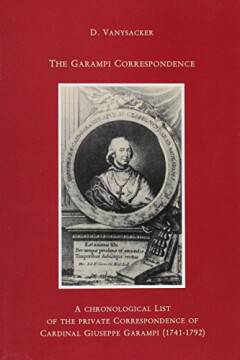
The Garampi Correspondence
A Chronological List of the Private Correspondence of Cardinal Giuseppe Garampi (1741-1792)
D Vanysacker
€ 24,00
+ 48 punten
Eenvoudig bestellen
Veilig betalen


Gratis thuislevering vanaf € 30 (via bpost)
Gratis levering in je Standaard Boekhandel
Omschrijving
It is to the credit of Dries Vanysacker that he has undertaken and completed the reconstruction of the private correspondence of Giuseppe Garampi. He discovered some fifteen thousand letters from and to this eighteenth century cardinal, scattered over archives and libraries from Rome to Copenhagen. He arranged them in chronological order, and added the necessary indexes and identifications of the correspondents. In his letters Garampi appears a faithful friend, a helpful colleague, a reliable agent and a sharp polemic, a man who played an important role in the ecclesiastical, intellectual and political history of many countries. His correspondence teaches much about his person, and about the group or movement of which he was the real leader: the ultramontane Internationale. His correspondence gives us an idea of the structure, size and importance of this movement. The mere list of the correpondents and the idea of the frequency of the contacts contribute to our knowledge of the eighteenth century Republique des letteres and the evolution of the Catholic Church.
Specificaties
Betrokkenen
- Auteur(s):
- Uitgeverij:
Inhoud
- Aantal bladzijden:
- 429
- Taal:
- Engels
- Reeks:
- Reeksnummer:
- nr. 19
Eigenschappen
- Productcode (EAN):
- 9789073683204
- Verschijningsdatum:
- 1/01/1997
- Uitvoering:
- Paperback
- Formaat:
- Trade paperback (VS)
- Gewicht:
- 449 g


Alleen bij Standaard Boekhandel
+ 48 punten op je klantenkaart van Standaard Boekhandel
CADEAU

AANGERADEN


Beoordelingen
We publiceren alleen reviews die voldoen aan de voorwaarden voor reviews. Bekijk onze voorwaarden voor reviews.