


- Afhalen na 1 uur in een winkel met voorraad
- Gratis thuislevering in België vanaf € 30
- Ruim aanbod met 7 miljoen producten
- Afhalen na 1 uur in een winkel met voorraad
- Gratis thuislevering in België vanaf € 30
- Ruim aanbod met 7 miljoen producten





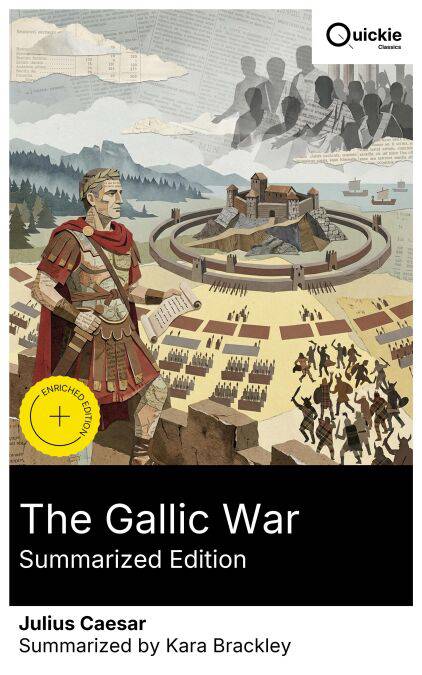
The Gallic War (Summarized Edition) E-BOOK
Enriched edition. Firsthand accounts of the conquest of Gaul—Roman campaigns, Gallic tribal clashes, strategy, and propaganda in ancient military narrative
Julius Caesar
E-book | Engels
€ 1,99
Omschrijving
The Gallic War is Caesar's spare, commanding narrative of the campaigns in Gaul (58–50 BCE), composed in the Commentarii mode. Written in taut, paratactic Latin and the third person, it interweaves precise logistics, topography, Alesia's siegecraft, and battle order with ethnographic sketches of Gauls, Germans, and Britons, and set-piece speeches that guide interpretation. At once field report and crafted literature, it stands at the hinge of late Republican historiography, balancing annalistic clarity with authorial self-fashioning, and establishing a model for military prose. As proconsul, Gaius Julius Caesar — indebted aristocrat, consummate politician, and innovator of coalition-building — needed victories and narrative control. These Commentaries circulated rapidly in Rome to influence Senate and people, legitimating unprecedented command extensions and overshadowing rivals like Pompey. The third-person stance feigns impartiality, while selective emphasis, casualty accounting, and moral contrasts advance a persuasive defense of conquest. This book repays close reading by historians, classicists, and strategists alike. Approach it as both source and argument, ideally alongside Cicero's correspondence, Plutarch, and modern commentaries, to triangulate its claims. For lucid tactics, statecraft under pressure, and the rhetoric of empire, few ancient works are more instructive.
Quickie Classics summarizes timeless works with precision, preserving the author's voice and keeping the prose clear, fast, and readable—distilled, never diluted. Enriched Edition extras: Introduction · Synopsis · Historical Context · Author Biography · Brief Analysis · 4 Reflection Q&As · Editorial Footnotes.
Quickie Classics summarizes timeless works with precision, preserving the author's voice and keeping the prose clear, fast, and readable—distilled, never diluted. Enriched Edition extras: Introduction · Synopsis · Historical Context · Author Biography · Brief Analysis · 4 Reflection Q&As · Editorial Footnotes.
Specificaties
Betrokkenen
- Auteur(s):
- Vertaler(s):
- Uitgeverij:
Inhoud
- Aantal bladzijden:
- 125
- Taal:
- Engels
Eigenschappen
- Productcode (EAN):
- 8596547880837
- Verschijningsdatum:
- 9/01/2026
- Uitvoering:
- E-book
- Beveiligd met:
- Digital watermarking
- Formaat:
- ePub


Alleen bij Standaard Boekhandel
Cadeau

AANGERADEN


Beoordelingen
We publiceren alleen reviews die voldoen aan de voorwaarden voor reviews. Bekijk onze voorwaarden voor reviews.