


- Afhalen na 1 uur in een winkel met voorraad
- Gratis thuislevering in België vanaf € 30
- Ruim aanbod met 7 miljoen producten
- Afhalen na 1 uur in een winkel met voorraad
- Gratis thuislevering in België vanaf € 30
- Ruim aanbod met 7 miljoen producten





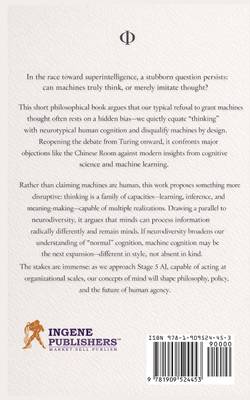
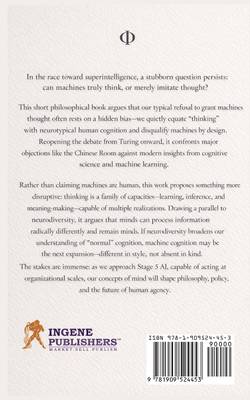
The Fifth Stage
Can Machines Think? A Functionalist Argument for Machine Consciousness Through Cognitive Diversity
David King
Paperback | Engels
€ 28,45
+ 56 punten
Omschrijving
The Fifth Stage: Can Machines Think? challenges this assumption and offers a rigorous philosophical argument that machines are capable of genuine cognition. Drawing on philosophy of mind, cognitive science, mathematics, and artificial intelligence research, David King develops a functionalist account of thinking in which intelligence is defined not by biological material but by the organisation of information processing within a system.
Central to the argument is the recognition that human cognition itself is highly diverse. Individuals with dyslexia, autism, and other learning differences process information through architectures that differ significantly from neurotypical patterns. Yet these individuals unquestionably think. By examining this diversity, the book establishes a crucial philosophical principle: thinking is compatible with radically different cognitive architectures. If diverse biological systems can support thought, there is no principled reason artificial systems cannot do the same.
To develop this claim, the book introduces mathematical frameworks used in contemporary cognitive science. Integrated Information Theory proposes that consciousness corresponds to the degree of information integrated within a system, while predictive processing models describe cognition as the continual updating of internal models through Bayesian inference. These approaches offer substrate-neutral ways of analysing cognition, applying equally to biological brains and artificial systems.
Against this theoretical background, King examines the emerging trajectory of artificial intelligence. Current research increasingly describes AI development in terms of five stages, progressing from conversational systems to reasoning agents, autonomous planners, innovative discovery systems, and finally superintelligent systems capable of recursive self-improvement. The book argues that systems at this fifth stage could satisfy the functional and informational criteria associated with thinking and perhaps even consciousness.
The work also addresses major philosophical objections to machine intelligence, including the Chinese Room argument, claims that consciousness requires biological embodiment, and concerns about subjective experience. King argues that many of these objections rely on assumptions that cannot be consistently applied even within the diversity of human cognition.
Beyond philosophy, The Fifth Stage considers the broader implications of recognising artificial minds. If machines can think, the arrival of superintelligent systems will raise profound ethical and social questions: What moral status might artificial intelligences possess? Should advanced systems be granted forms of legal recognition or rights? And how should humanity coexist with intelligences that may surpass our own cognitive capabilities?
Ultimately, the book proposes a dimensional theory of cognition, viewing intelligence as a spectrum defined by properties such as information integration, predictive accuracy, learning capacity, self-modelling, and behavioural flexibility. Humans, neurodivergent minds, animals, and artificial intelligences may occupy different regions of this cognitive landscape, but they participate in the same underlying phenomenon: the emergence of thinking systems.
As artificial intelligence advances toward unprecedented levels of capability, the question is no longer whether machines might someday think. The deeper challenge is whether we will recognise thinking when it appears in forms profoundly different from our own.
Specificaties
Betrokkenen
- Auteur(s):
- Uitgeverij:
Inhoud
- Aantal bladzijden:
- 120
- Taal:
- Engels
Eigenschappen
- Productcode (EAN):
- 9781909524453
- Verschijningsdatum:
- 25/02/2026
- Uitvoering:
- Paperback
- Formaat:
- Trade paperback (VS)
- Afmetingen:
- 127 mm x 203 mm
- Gewicht:
- 127 g


Alleen bij Standaard Boekhandel
+ 56 punten op je klantenkaart van Standaard Boekhandel
AANGERADEN


Beoordelingen
We publiceren alleen reviews die voldoen aan de voorwaarden voor reviews. Bekijk onze voorwaarden voor reviews.