



Je cadeautjes zeker op tijd in huis hebben voor de feestdagen? Kom langs in onze winkels en vind het perfecte geschenk!
- Afhalen na 1 uur in een winkel met voorraad
- Gratis thuislevering in België vanaf € 30
- Ruim aanbod met 7 miljoen producten
Je cadeautjes zeker op tijd in huis hebben voor de feestdagen? Kom langs in onze winkels en vind het perfecte geschenk!
- Afhalen na 1 uur in een winkel met voorraad
- Gratis thuislevering in België vanaf € 30
- Ruim aanbod met 7 miljoen producten





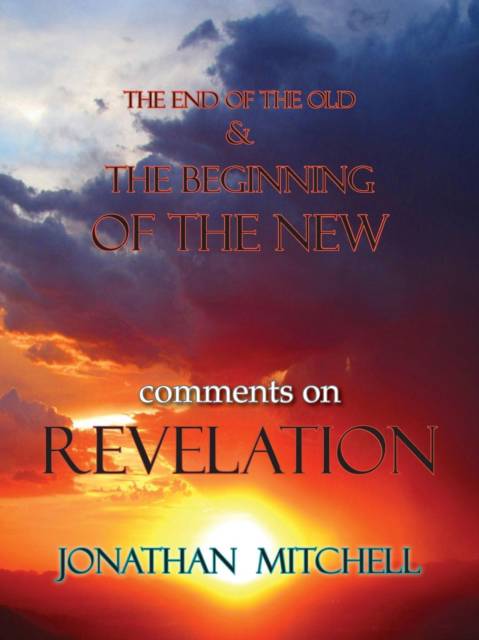
The End of the Old and the Beginning of the New, Comments on Revelation
Jonathan Paul Mitchell
Paperback | Engels
€ 69,45
+ 138 punten
Omschrijving
This is a commentary on Revelation, an apocalyptic book given for the called-out communities in 1st century AD Asia Minor. It is based upon the author's translation of the Greek text. Its purpose is to reveal light that this expanded translation (with multiple renderings) will shed upon our understanding of what John was telling his listeners. In this work we consider the views of a variety of scholars, but this endeavor is to provide a fresh interpretation of the text. It is intended to reveal both immediate and underlying messages, as we currently perceive them. With an approach to the text in its historical context, a non-literal, metaphorical methodology is followed that allows the Scriptures that the first century author would have drawn upon (the Hebrew Bible, or OT) to supply the meanings of the apocalyptic symbolism. We have turned to the writings of other 1st century authors to inform our understanding of the text. Apocalyptic literature was popular in Second Temple Judaism from around 200 BC to approximately AD 100. About a third of the verses in Revelation reflect passages from the Hebrew Bible. We will present a primarily preterist, or, "already fulfilled," interpretation which views the text as speaking of events that were fulfilled, or inaugurated, in the generation in which John lived. Added to this are comments on what this means to us in our day. We see this book as an apocalyptic Gospel. It is filled with good news. It begins with a vision of the resurrected Christ and an introduction to the entire book. In chapters 2-3, John is given letters for the called-out communities in Asia Minor. Next is a series of visions concerning which, in 1:19, he is told to write of "the things you see, and the things presently existing, as well as which things are progressively about to occur after these things." The structure of the following visions are presented as different symbolic pictures of scenarios that presently existed in God's new creation, and of things that would culminate in the destruction of AD 70 Jerusalem. The relationship between Jerusalem and the Roman Empire is addressed, and then we see a picture of Christ's body as the New, Heavenly Jerusalem. The story echoes Israel's Exodus and later cultus that the NT writers present as pointers to the work of the Messiah. Like the figures and prophecies in the OT, here their counterparts spoke of literal, existing and soon-coming realities of 1st century AD Judea, yet also pointed to the realities of the inaugurated new age of the Messiah. Through this, we can observe inter-relating threads that combine to form a unified tapestry. Examples observed from the OT are the tabernacle/temple, lampstand, throne (the ark), brass laver, and cherubim embroidered into the curtains and on the mercy seat. The temple is the center from which the 7 plagues are sent out. The settings change with chapter 17, and the rest of the visions move from the temple out into the two cities which are the main topics for the remainder of the book (an echo from Heb. 12:22). The temple-associated symbols in the visions correspond to the new creation situation: "temple" represents the corporate body of Christ. One tradition that is challenged in this work is the assumption that there is a reference to a "final" judgment in Revelation. A corollary of that traditional view is that Revelation speaks about "the end of human history," which we reject as being unsupportable from the text. No, instead this book is about the beginning of the New Humanity (1 Cor. 15:45-49). A central focus of the entire book is the new creation which Paul apocalyptically understood to be a present reality (2 Cor. 5:17). Revelation is about The End of the Old covenant, and The Beginning of the New covenant, Good News for all of humanity!
Specificaties
Betrokkenen
- Auteur(s):
- Uitgeverij:
Inhoud
- Aantal bladzijden:
- 690
- Taal:
- Engels
Eigenschappen
- Productcode (EAN):
- 9781732120501
- Verschijningsdatum:
- 22/07/2018
- Uitvoering:
- Paperback
- Formaat:
- Trade paperback (VS)
- Afmetingen:
- 210 mm x 279 mm
- Gewicht:
- 1524 g


Alleen bij Standaard Boekhandel
+ 138 punten op je klantenkaart van Standaard Boekhandel
CADEAU


Beoordelingen
We publiceren alleen reviews die voldoen aan de voorwaarden voor reviews. Bekijk onze voorwaarden voor reviews.