


- Afhalen na 1 uur in een winkel met voorraad
- Gratis thuislevering in België vanaf € 30
- Ruim aanbod met 7 miljoen producten
- Afhalen na 1 uur in een winkel met voorraad
- Gratis thuislevering in België vanaf € 30
- Ruim aanbod met 7 miljoen producten





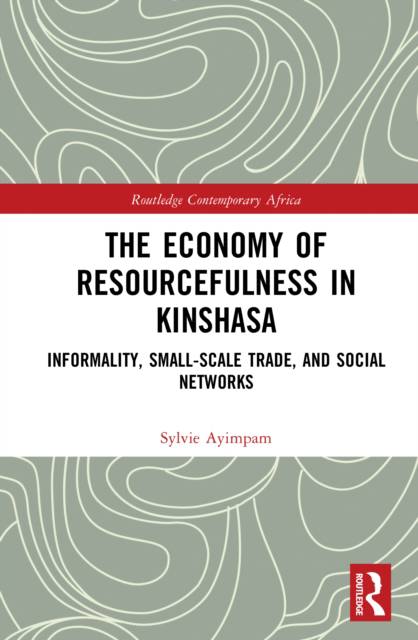
The Economy of Resourcefulness in Kinshasa
Informality, Small-Scale Trade, and Social Networks
Sylvie Ayimpam
€ 305,45
+ 610 punten
Omschrijving
How, in a context of prolonged economic and political crisis, do city dwellers reinvent the means of their survival in Kinshasa? This book answers that question. Through fine-grained ethnography, it shows how micro-social arrangements enable small-scale traders to provision the city and ordinary citizens to keep living, immersing the reader in the many forms of "resourcefulness" that organize small-scale trade across Kinshasa's markets.
The book moves beyond the formal/informal binary to theorize an "economy of resourcefulness," where economic, social, political, and cultural dimensions are tightly entangled. It traces how cooperation and cunning, solidarity and extortion, coexist in everyday pursuits of income under precarious conditions. Following retail circuits while attending to shifting state presences, digital payments, congestion, and risk, it reconstructs the practical norms and negotiated rules through which actors coordinate, conflict, and protect themselves--offering a bottom-up view of governance in practice and of ongoing social change.
This volume will interest scholars and students of African studies, anthropology, sociology, political science, geography, urban studies, and development studies, as well as practitioners concerned with popular economies, urban governance, and everyday livelihoods in the Global South.
Specificaties
Betrokkenen
- Auteur(s):
- Uitgeverij:
Inhoud
- Aantal bladzijden:
- 264
- Taal:
- Engels
- Reeks:
Eigenschappen
- Productcode (EAN):
- 9781041270928
- Verschijningsdatum:
- 16/06/2026
- Uitvoering:
- Hardcover
- Formaat:
- Genaaid
- Afmetingen:
- 156 mm x 234 mm
- Gewicht:
- 580 g


Alleen bij Standaard Boekhandel
+ 610 punten op je klantenkaart van Standaard Boekhandel
Cadeau

AANGERADEN


Beoordelingen
We publiceren alleen reviews die voldoen aan de voorwaarden voor reviews. Bekijk onze voorwaarden voor reviews.