



- Afhalen na 1 uur in een winkel met voorraad
- In januari gratis thuislevering in België
- Ruim aanbod met 7 miljoen producten
- Afhalen na 1 uur in een winkel met voorraad
- In januari gratis thuislevering in België
- Ruim aanbod met 7 miljoen producten





€ 2,99
+ 2 punten
Omschrijving
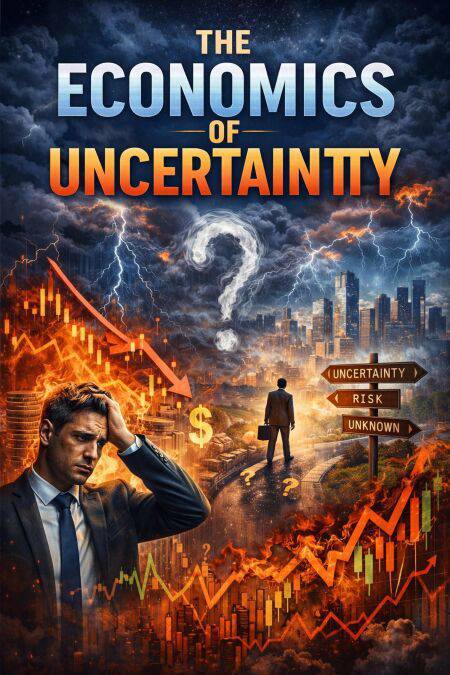
The Economics of Uncertainty is a comprehensive and intellectually ambitious work that confronts one of the most consequential and chronically underappreciated forces shaping economic life: the irreducible uncertainty that pervades every transaction, investment, policy decision, and individual choice in the modern world. Written for the informed general reader as much as for the specialist economist, this book charts a bold course through the history, theory, and practical implications of uncertainty in economics — arguing, with force and clarity, that the discipline's long habit of treating uncertainty as a manageable inconvenience rather than a defining condition has produced not merely intellectual error but real-world catastrophe.
The book opens by drawing the foundational distinction between risk — the domain of measurable probability — and genuine Knightian uncertainty, where the future resists quantification entirely. From this conceptual foundation, it traces the history of economic thought from Adam Smith's invisible hand through Keynes's animal spirits, Frank Knight's theory of entrepreneurial profit, and the behavioral revolution inaugurated by Kahneman and Tversky — revealing how successive generations of economists have grappled with, and too often suppressed, the problem of the unknowable.
Subsequent chapters move systematically across the terrain of economic life. The behavior of financial markets — their capacity to aggregate information and their equally powerful capacity to amplify collective delusion — is examined with unflinching attention to bubbles, crashes, and the systemic failures that periodically remind us how fragile market-based coordination truly is. The analysis extends to corporate strategy, where scenario planning and real options theory offer frameworks for decision-making that respect rather than deny uncertainty; to the macroeconomy, where uncertainty shocks freeze investment, central banks manage expectations as much as interest rates, and pandemics expose the fragility of optimized systems; and to innovation, where creative destruction, venture capital, and the productive function of failure illuminate the deep connection between entrepreneurial uncertainty and economic progress.
The book then turns to the larger forces that shape the landscape of economic uncertainty: geopolitical rivalry and the weaponization of trade, the existential uncertainties of climate change and environmental degradation, the disruptive potential of artificial intelligence and automation for labor markets, and the fundamental role of institutions — the rule of law, property rights, accountable governance — as the indispensable infrastructure of economic predictability. Throughout, the analysis is grounded in historical cases, empirical evidence, and the insights of the most penetrating economic thinkers of the past century.
The concluding chapters bring the argument home to the individual — offering a framework for personal and professional decision-making under uncertainty grounded in diversification, optionality, and the cultivation of adaptive resilience — before offering a vision of a new economics adequate to the complexity of the twenty-first century: one built on intellectual humility, behavioral realism, and the honest acknowledgment of what markets, models, and policymakers cannot know.
The Economics of Uncertainty is, ultimately, a book about wisdom — the wisdom of engaging with the world as it is, rather than as simpler models wish it to be. It is essential reading for economists, policymakers, business leaders, and anyone who seeks to understand the forces that shape prosperity, crisis, and human possibility in an irreducibly uncertain world.
Disclaimer:- This is AI Generated Content.
Specificaties
Betrokkenen
- Auteur(s):
- Uitgeverij:
Inhoud
- Taal:
- Engels
Eigenschappen
- Productcode (EAN):
- 9798224135295
- Verschijningsdatum:
- 11/03/2026
- Uitvoering:
- E-book
- Formaat:
- ePub


Alleen bij Standaard Boekhandel
+ 2 punten op je klantenkaart van Standaard Boekhandel
Cadeau

AANGERADEN


Beoordelingen
We publiceren alleen reviews die voldoen aan de voorwaarden voor reviews. Bekijk onze voorwaarden voor reviews.