


- Afhalen na 1 uur in een winkel met voorraad
- Gratis thuislevering in België vanaf € 30
- Ruim aanbod met 7 miljoen producten
- Afhalen na 1 uur in een winkel met voorraad
- Gratis thuislevering in België vanaf € 30
- Ruim aanbod met 7 miljoen producten





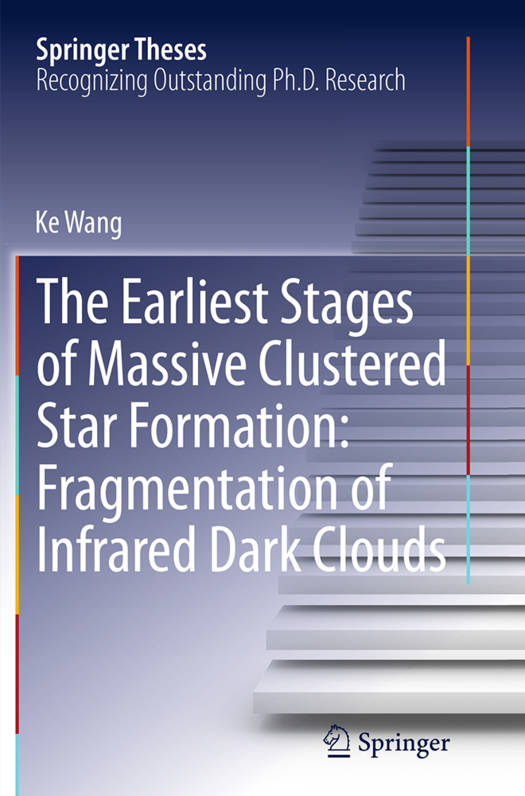
The Earliest Stages of Massive Clustered Star Formation: Fragmentation of Infrared Dark Clouds
Ke Wang
€ 54,45
+ 108 punten
Uitvoering
Omschrijving
This thesis presents an in-depth, high-resolution observational study on the very beginning of the formation process: the fragmentation of dense molecular clouds known as infrared dark clouds (IRDCs). Using the Submillimeter Array (SMA) and Very Large Array (VLA) radio interferometers, the author has discovered a common picture of hierarchical fragmentation that challenges some of the leading theoretical models and suggests a new, observation-driven understanding of how massive star formation in clustered environments may begin: it is initiated by the hierarchical fragmentation of a dense filament from 10 pc down to 0.01 pc, and the stellar mass buildup is simultaneously fed by hierarchical accretion at similar scales. The new scenario points out the importance of turbulence and filamentary structure, which are now receiving increasing attention and further tests from both observers and theorists.
Specificaties
Betrokkenen
- Auteur(s):
- Uitgeverij:
Inhoud
- Aantal bladzijden:
- 145
- Taal:
- Engels
- Reeks:
Eigenschappen
- Productcode (EAN):
- 9783662524282
- Verschijningsdatum:
- 11/08/2016
- Uitvoering:
- Paperback
- Afmetingen:
- 161 mm x 236 mm
- Gewicht:
- 265 g


Alleen bij Standaard Boekhandel
+ 108 punten op je klantenkaart van Standaard Boekhandel
Cadeau

AANGERADEN


Beoordelingen
We publiceren alleen reviews die voldoen aan de voorwaarden voor reviews. Bekijk onze voorwaarden voor reviews.