


- Afhalen na 1 uur in een winkel met voorraad
- Gratis thuislevering in België vanaf € 30
- Ruim aanbod met 7 miljoen producten
- Afhalen na 1 uur in een winkel met voorraad
- Gratis thuislevering in België vanaf € 30
- Ruim aanbod met 7 miljoen producten




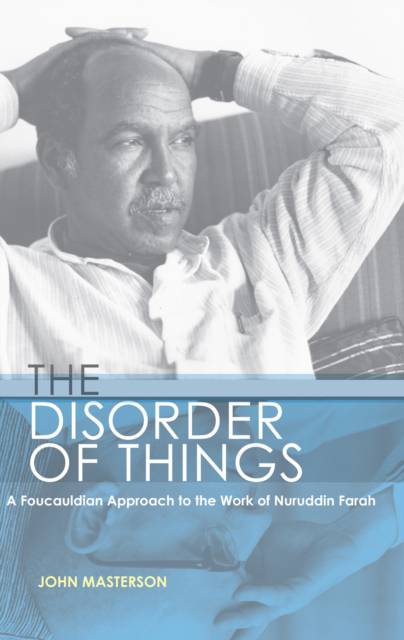
The Disorder of Things
A Foucauldian Approach to the Work of Nuruddin Farah
John Masterson
Paperback | Engels
€ 33,95
+ 67 punten
Omschrijving
Nuruddin Farah is widely regarded as one of the most sophisticated voices in contemporary world literature. Michel Foucault is revered as one of the most important thinkers of the twentieth century, with his discursive legacy providing inspiration for scholars working in a range of interdisciplinary fields. The Disorder of Things offers a reading of the Somali novelist through the prism of the French philosopher. The book argues that the preoccupations that have remained central throughout Farah's forty year career, including political autocracy, female infibulation, border conflicts, international aid and development, civil war, transnational migration and the Horn of Africa's place in a so-called 'axis of evil', can be mapped onto some key concerns in Foucault's writing most notably Foucault's theoretical turn from 'disciplinary' to 'biopolitical' power. In both the colonial past and the postcolonial present, Somalia is typically represented as an incubator of disorder: whether in relation to internecine conflict, international terrorism or contemporary piracy. Through his work, both fictional and non-fictional, Farah strives to present alternative stories to an expanding global readership. The Disorder of Things analyses the politics and poetics that underpin this literary project, beginning with Farah's first fictional cycle, Variations on the Theme of an African Dictatorship (1979-1983), and ending with his Past Imperfect trilogy (2004-2011). Farah's writing calls for a more refined, substantial reading of our current geo-political situation. As such, it both warrants and compels the kind of critical engagement foregrounded throughout The Disorder of Things. This book will appeal to students, academics and general readers with an interest in the interdisciplinary study of literature. Its engagement with theorists, drawn from postcolonial, feminist and development studies, set against the backdrop of a host of philosophical and sociological discourses, shows how such intellectual cross-fertilisation can enliven a single-author study.
Specificaties
Betrokkenen
- Auteur(s):
- Uitgeverij:
Inhoud
- Aantal bladzijden:
- 320
- Taal:
- Engels
Eigenschappen
- Productcode (EAN):
- 9781868145706
- Verschijningsdatum:
- 1/04/2013
- Uitvoering:
- Paperback
- Formaat:
- Trade paperback (VS)
- Afmetingen:
- 155 mm x 229 mm
- Gewicht:
- 476 g



Alleen bij Standaard Boekhandel
+ 67 punten op je klantenkaart van Standaard Boekhandel
CADEAU


Beoordelingen
We publiceren alleen reviews die voldoen aan de voorwaarden voor reviews. Bekijk onze voorwaarden voor reviews.