


- Afhalen na 1 uur in een winkel met voorraad
- Gratis thuislevering in België vanaf € 30
- Ruim aanbod met 7 miljoen producten
- Afhalen na 1 uur in een winkel met voorraad
- Gratis thuislevering in België vanaf € 30
- Ruim aanbod met 7 miljoen producten





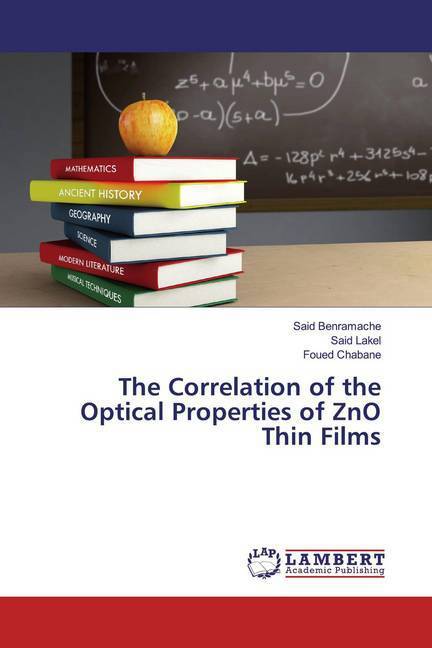
The Correlation of the Optical Properties of ZnO Thin Films
Said Benramache, Said Lakel, Foued Chabane
Paperback | Engels
€ 39,45
+ 78 punten
Omschrijving
In the present work, we used the optical properties of pure and doped zinc oxide thin films as the n-type semiconductor. The thin films were deposited at different precursor molarities by ultrasonic spray and spray pyrolysis techniques also at different substrate temperatures, the ZnO doped with various dopant's such as Al, In, Co, Ni, Sn, V, Fe, F, Sn doped ZnO thin films. In this work the attention was focused on the presently new approach to calculate the optical gap energy and Urbach energies. The model proposed to calculate the band gap or the Urbach energies of undoped and doped ZnO thin films were studied. The relation between the experimental data and theoretical calculation with precursor molarities suggests that the band gap or the Urbach energies are predominantly estimated by the band gap or the Urbach energies and the concentration of ZnO solution.
Specificaties
Betrokkenen
- Auteur(s):
- Uitgeverij:
Inhoud
- Aantal bladzijden:
- 52
- Taal:
- Engels
Eigenschappen
- Productcode (EAN):
- 9783659791154
- Uitvoering:
- Paperback
- Afmetingen:
- 150 mm x 220 mm


Alleen bij Standaard Boekhandel
+ 78 punten op je klantenkaart van Standaard Boekhandel

Beoordelingen
We publiceren alleen reviews die voldoen aan de voorwaarden voor reviews. Bekijk onze voorwaarden voor reviews.