


- Afhalen na 1 uur in een winkel met voorraad
- Gratis thuislevering in België vanaf € 30
- Ruim aanbod met 7 miljoen producten
- Afhalen na 1 uur in een winkel met voorraad
- Gratis thuislevering in België vanaf € 30
- Ruim aanbod met 7 miljoen producten





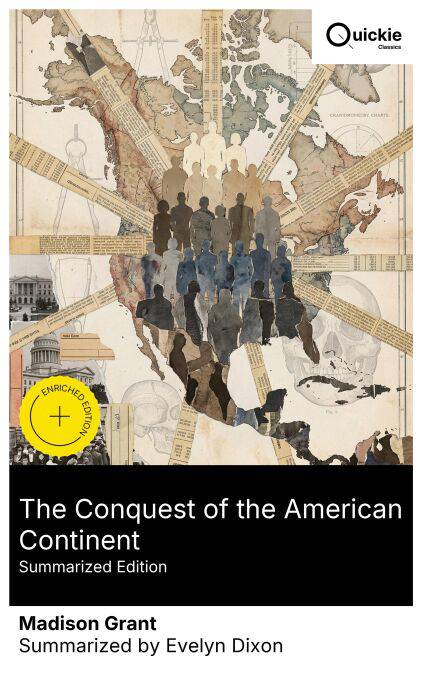
The Conquest of the American Continent (Summarized Edition) E-BOOK
Enriched edition. European Colonization, Migration Patterns, and Power: Early America's Social Hierarchy and the Roots of Scientific Racism
Madison Grant
E-book | Engels
€ 0,49
Omschrijving
The Conquest of the American Continent (1933) presents a sweeping, polemical history of North America cast as the competitive expansion of 'races.' Mixing frontier chronicle with pseudo-scientific typologies, Madison Grant advances a Nordicist thesis that reads settlement, migration, and nation-building through hereditarian hierarchy. Written in categorical, programmatic prose, it stitches statistics, ethnological speculation, and broad generalizations into a deterministic narrative aligned with interwar eugenic discourse and nativist anxieties. Grant, a patrician New Yorker, conservationist leader, and prominent eugenicist, had elaborated these views in The Passing of the Great Race. His stewardship of elite institutions and lobbying for immigration restriction fostered a conviction that national vitality hinged on selective heredity. Drawing on networks of racial anthropologists and policy reformers, he wrote this volume to popularize a hierarchical framework he thought should guide demographic policy. Best approached as a revealing primary source rather than reliable history, the book suits readers of American intellectual history, immigration, and race. Recommended for those prepared to interrogate its claims alongside contemporary scholarship, it illuminates the genealogy and policy reach of scientific racism and interwar nativism.
Quickie Classics summarizes timeless works with precision, preserving the author's voice and keeping the prose clear, fast, and readable—distilled, never diluted. Enriched Edition extras: Introduction · Synopsis · Historical Context · Brief Analysis · 4 Reflection Q&As · Editorial Footnotes.
Quickie Classics summarizes timeless works with precision, preserving the author's voice and keeping the prose clear, fast, and readable—distilled, never diluted. Enriched Edition extras: Introduction · Synopsis · Historical Context · Brief Analysis · 4 Reflection Q&As · Editorial Footnotes.
Specificaties
Betrokkenen
- Auteur(s):
- Uitgeverij:
Inhoud
- Aantal bladzijden:
- 133
- Taal:
- Engels
Eigenschappen
- Productcode (EAN):
- 8596547882305
- Verschijningsdatum:
- 9/01/2026
- Uitvoering:
- E-book
- Beveiligd met:
- Digital watermarking
- Formaat:
- ePub



Alleen bij Standaard Boekhandel
AANGERADEN


Beoordelingen
We publiceren alleen reviews die voldoen aan de voorwaarden voor reviews. Bekijk onze voorwaarden voor reviews.