


- Afhalen na 1 uur in een winkel met voorraad
- Gratis thuislevering in België vanaf € 30
- Ruim aanbod met 7 miljoen producten
- Afhalen na 1 uur in een winkel met voorraad
- Gratis thuislevering in België vanaf € 30
- Ruim aanbod met 7 miljoen producten





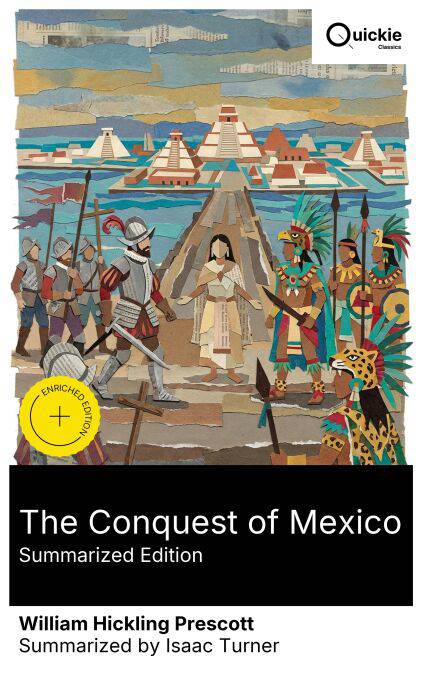
The Conquest of Mexico (Summarized Edition) E-BOOK
Enriched edition. Aztec Empire, Spanish conquest, and the clash of cultures in 16th‑century Mexico—battles, intrigue, and the legacy of colonization
William Hickling Prescott
E-book | Engels
€ 1,99
+ 1 punten
Omschrijving
William Hickling Prescott's The Conquest of Mexico offers a sweeping narrative of Hernán Cortés's campaign against the Mexica, from the landing at Veracruz and the Tlaxcalan alliance to the Noche Triste and the siege of Tenochtitlan. In polished prose buttressed by notes, Prescott interweaves political, military, and ethnographic strands, drawing on the Cartas de Relación, Bernal Díaz del Castillo, and early ecclesiastical chronicles. As a Romantic-era history, it pairs moral reflection with dramatic set pieces. Prescott, a Bostonian scholar educated at Harvard, composed much of this work while nearly blind, dictating to amanuenses and accessing Spanish archives through transcripts and correspondence. His method—collating rival eyewitnesses against state papers—shows disciplined, proto-critical historicism, even as his Anglo-American, Protestant milieu and antebellum debates about expansion shaped his emphases. Fascinated by civilizational encounter, he aimed to explain both Spanish audacity and Mexica statecraft without reducing either to caricature. This classic warrants contemporary reading for its narrative power and documentary ambition, and as a case study in the making of imperial historiography. Readers of global empire, Indigenous studies, and narrative history will find it rewarding—best approached alongside modern Mesoamerican scholarship that complicates its Eurocentric frames.
Quickie Classics summarizes timeless works with precision, preserving the author's voice and keeping the prose clear, fast, and readable—distilled, never diluted. Enriched Edition extras: Introduction · Synopsis · Historical Context · Author Biography · Brief Analysis · 4 Reflection Q&As · Editorial Footnotes.
Quickie Classics summarizes timeless works with precision, preserving the author's voice and keeping the prose clear, fast, and readable—distilled, never diluted. Enriched Edition extras: Introduction · Synopsis · Historical Context · Author Biography · Brief Analysis · 4 Reflection Q&As · Editorial Footnotes.
Specificaties
Betrokkenen
- Auteur(s):
- Uitgeverij:
Inhoud
- Aantal bladzijden:
- 352
- Taal:
- Engels
Eigenschappen
- Productcode (EAN):
- 8596547883005
- Verschijningsdatum:
- 9/01/2026
- Uitvoering:
- E-book
- Beveiligd met:
- Digital watermarking
- Formaat:
- ePub


Alleen bij Standaard Boekhandel
+ 1 punten op je klantenkaart van Standaard Boekhandel
AANGERADEN


Beoordelingen
We publiceren alleen reviews die voldoen aan de voorwaarden voor reviews. Bekijk onze voorwaarden voor reviews.