



Je cadeautjes zeker op tijd in huis hebben voor de feestdagen? Kom langs in onze winkels en vind het perfecte geschenk!
- Afhalen na 1 uur in een winkel met voorraad
- Gratis thuislevering in België vanaf € 30
- Ruim aanbod met 7 miljoen producten
Je cadeautjes zeker op tijd in huis hebben voor de feestdagen? Kom langs in onze winkels en vind het perfecte geschenk!
- Afhalen na 1 uur in een winkel met voorraad
- Gratis thuislevering in België vanaf € 30
- Ruim aanbod met 7 miljoen producten





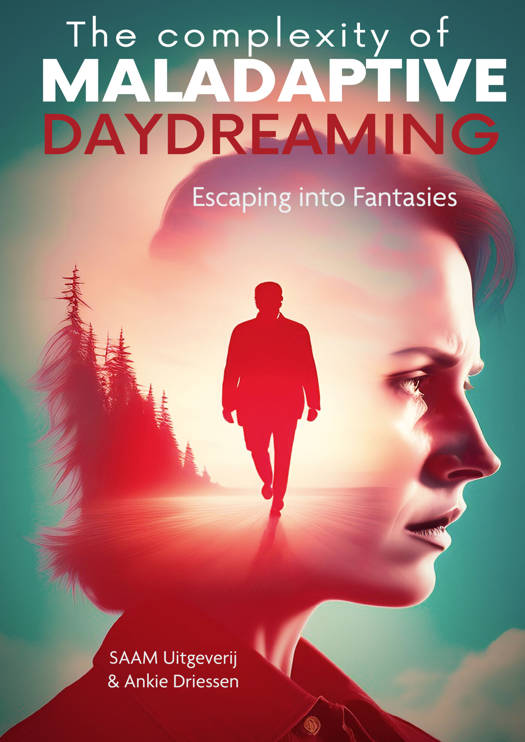
The Complexity of Maladaptive Daydreaming
Escaping into Fantasies
Saam Uitgeverij, Ankie Driessen
Paperback | Engels
€ 17,95
+ 35 punten
Omschrijving
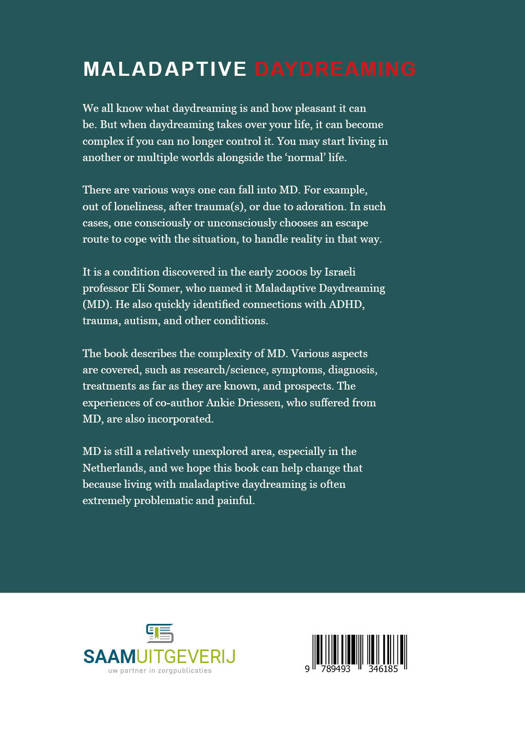
We all know what daydreaming is and how pleasant it can be. But when daydreaming takes over your life, it can become complex if you can no longer control it. You may start living in another or multiple worlds alongside the ‘normal’ life.
There are various ways one can fall into MD. For example, out of loneliness, after trauma(s), or due to adoration. In such cases, one consciously or unconsciously chooses an escape route to cope with the situation, to handle reality in that way.
It is a condition discovered in the early 2000s by Israeli professor Eli Somer, who named it Maladaptive Daydreaming (MD). He also quickly identified connections with ADHD, trauma, autism, and other conditions.
The book describes the complexity of MD. Various aspects are covered, such as research/science, symptoms, diagnosis, treatments as far as they are known, and prospects. The experiences of co-author Ankie Driessen, who suffered from MD, are also incorporated.
MD is still a relatively unexplored area, especially in the Netherlands, and we hope this book can help change that because living with maladaptive daydreaming is often extremely problematic and painful.
There are various ways one can fall into MD. For example, out of loneliness, after trauma(s), or due to adoration. In such cases, one consciously or unconsciously chooses an escape route to cope with the situation, to handle reality in that way.
It is a condition discovered in the early 2000s by Israeli professor Eli Somer, who named it Maladaptive Daydreaming (MD). He also quickly identified connections with ADHD, trauma, autism, and other conditions.
The book describes the complexity of MD. Various aspects are covered, such as research/science, symptoms, diagnosis, treatments as far as they are known, and prospects. The experiences of co-author Ankie Driessen, who suffered from MD, are also incorporated.
MD is still a relatively unexplored area, especially in the Netherlands, and we hope this book can help change that because living with maladaptive daydreaming is often extremely problematic and painful.
Specificaties
Betrokkenen
- Auteur(s):
- Uitgeverij:
Inhoud
- Aantal bladzijden:
- 96
- Taal:
- Engels
Eigenschappen
- Productcode (EAN):
- 9789493346185
- Verschijningsdatum:
- 3/10/2024
- Uitvoering:
- Paperback
- Afmetingen:
- 172 mm x 243 mm
- Gewicht:
- 251 g


Alleen bij Standaard Boekhandel
+ 35 punten op je klantenkaart van Standaard Boekhandel
CADEAU


Beoordelingen
We publiceren alleen reviews die voldoen aan de voorwaarden voor reviews. Bekijk onze voorwaarden voor reviews.