


- Afhalen na 1 uur in een winkel met voorraad
- Gratis thuislevering in België vanaf € 30
- Ruim aanbod met 7 miljoen producten
- Afhalen na 1 uur in een winkel met voorraad
- Gratis thuislevering in België vanaf € 30
- Ruim aanbod met 7 miljoen producten





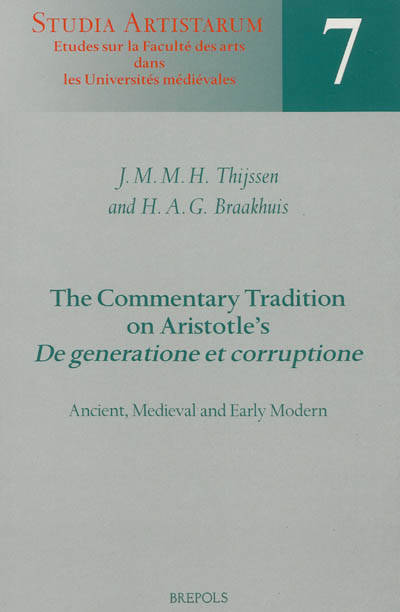
The commentary tradition on Aristotle's De generatione et corruptione
ancient, medieval, and early modern
J.M.M.H. Thijssen
€ 53,00
+ 106 punten
Omschrijving
In this book, a dozen distinguished scholars in the field of the history of philosophy
and science investigate aspects of the commentary tradition on Aristotle's
De generatione et corruptione, one of the least studied among Aristotle's treatises in
natural philosophy. Many famous thinkers such as Johannes Philoponus, Albert
the Great, Thomas Aquinas, John Buridan, Nicole Oresme, Francesco Piccolomini,
Jacopo Zabarella, and Galileo Galilei wrote commentaries on it. The distinctive
feature of the present book is that it approaches this commentary tradition as a
coherent whole, thereby ignoring the usual historiographical distinctions between
the Middle Ages, the Renaissance, and the seventeenth century.
Frans de Haas and Henk Kubbinga address the Greek commentary tradition on
De generatione et corruptione. Simone van Riet's essay is devoted to the Latin version of
Avicenna's third treatise of his Kitab al Shifa, which discusses Aristotle's De generatione
et corruptione. James Otte traces the intricate history of the identification of the Latin
translator of Aristotle's treatise as Burgund of Pisa. The essay by John Murdoch
explores the fortuna of atomistic arguments in the Latin commentary tradition.
Jürgen Sarnowsky, Henk Braakhuis, and Stefano Caroti examine various themes
in the commentaries that were produced by the so-called Buridan School, that is,
John Buridan, Albert of Saxony, Nicholas Oresme, and Marsilius of Inghen. The
article by Silvia Donati focuses on the influential commentary by the Expositor,
Giles of Rome. The final essay, written by Anita Guerrini, tackles Robert Boyle's
attitude in The Origin of Forms and Qualities toward such Aristotelian key concepts as
forms, matter, qualities, and mixture. These essays are prefaced by a preliminary
survey by Hans Thijssen of Aristotle's text, its Latin translations and its Greek,
Arabic and Latin commentaries.
Specificaties
Betrokkenen
- Auteur(s):
- Uitgeverij:
Inhoud
- Aantal bladzijden:
- 238
- Taal:
- Frans
- Reeks:
- Reeksnummer:
- nr. 7
Eigenschappen
- Productcode (EAN):
- 9782503508962
- Verschijningsdatum:
- 15/01/1999
- Uitvoering:
- Paperback
- Formaat:
- Trade paperback (VS)
- Afmetingen:
- 160 mm x 240 mm
- Gewicht:
- 440 g


Alleen bij Standaard Boekhandel
+ 106 punten op je klantenkaart van Standaard Boekhandel
Cadeau

AANGERADEN


Beoordelingen
We publiceren alleen reviews die voldoen aan de voorwaarden voor reviews. Bekijk onze voorwaarden voor reviews.