


- Afhalen na 1 uur in een winkel met voorraad
- Gratis thuislevering in België vanaf € 30
- Ruim aanbod met 7 miljoen producten
- Afhalen na 1 uur in een winkel met voorraad
- Gratis thuislevering in België vanaf € 30
- Ruim aanbod met 7 miljoen producten





€ 11,49
+ 11 punten
Uitvoering
Eenvoudig bestellen
Veilig betalen


Onmiddellijk geleverd via e-mail
Omschrijving
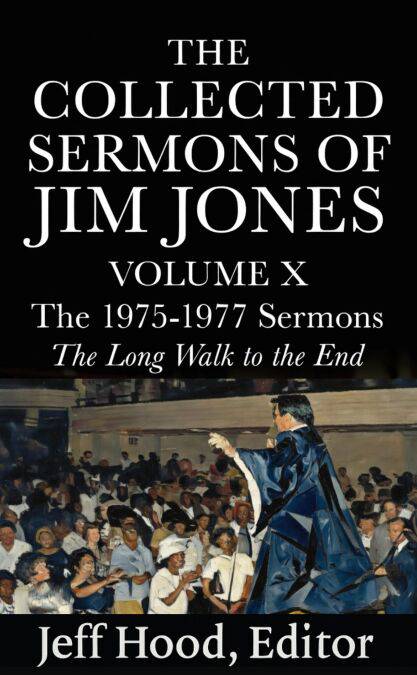
The Collected Sermons of Jim Jones, Volume X: The 1975–1977 Sermons — The Long Walk to the End presents eleven full sermon transcripts from the federally catalogued Q-number archive — Q1018, Q1028a-3, Q1056-4, Q162, Q454, Q162 (Philadelphia 1976), Q965, Q969, Q945, Q987, and Q1028a-2 — covering the final three years before the catastrophe of November 18, 1978. This is the last volume in the series, and it reads like one.
By 1975, the Peoples Temple was under serious external scrutiny. Defectors were speaking to journalists. New West magazine was preparing the exposé that would run in 1977 and accelerate the community's relocation to Guyana. The sermons gathered here are the record of a community closing in on itself and a leader tightening his grip on everything inside the closing circle. Jones speaks increasingly of siege, of betrayal, of the suffering he endures on behalf of his people. The performance of sacrificial martyrdom — always present in his preaching — has by 1977 become something harder and more final. In the closing sermon of this volume, the 1977 Crucifixion sermon (Q1028a-2), Jones identifies himself fully with the suffering Christ and begins preparing his congregation for what he is, at some level, already planning. He has decided the cross is coming. He has not yet told his congregation how many of them will be nailed to it alongside him.
And yet these are not simply the sermons of a man in collapse. The 1975 Extraterrestrial sermon elaborates Jones's full cosmological framework — his claim to origins on a higher planetary civilization, his authority as something beyond the merely religious or political, his assertion that he descended to earth specifically to save the people in his congregation. The sermon on Mormonism delivers a sustained and detailed critique of that tradition's racial theology. The witchcraft sermon, one of the most surprising in the collection, locates the historical persecution of witches within a broader pattern of religious violence against women and the poor — more feminist in its analysis than Jones is usually credited for being. The Pentecost sermon of 1977 engages seriously with charismatic tradition. Jones was, until very near the end, capable of serious religious and political thought. This is not a comfort. It is a fact that makes the catastrophe harder to explain and more important to understand.
Specificaties
Betrokkenen
- Auteur(s):
- Uitgeverij:
Inhoud
- Taal:
- Engels
- Reeks:
Eigenschappen
- Productcode (EAN):
- 9798233150876
- Verschijningsdatum:
- 23/03/2026
- Uitvoering:
- E-book
- Formaat:
- ePub



Alleen bij Standaard Boekhandel
+ 11 punten op je klantenkaart van Standaard Boekhandel
CADEAU

AANGERADEN


Beoordelingen
We publiceren alleen reviews die voldoen aan de voorwaarden voor reviews. Bekijk onze voorwaarden voor reviews.