


- Afhalen na 1 uur in een winkel met voorraad
- Gratis thuislevering in België vanaf € 30
- Ruim aanbod met 7 miljoen producten
- Afhalen na 1 uur in een winkel met voorraad
- Gratis thuislevering in België vanaf € 30
- Ruim aanbod met 7 miljoen producten




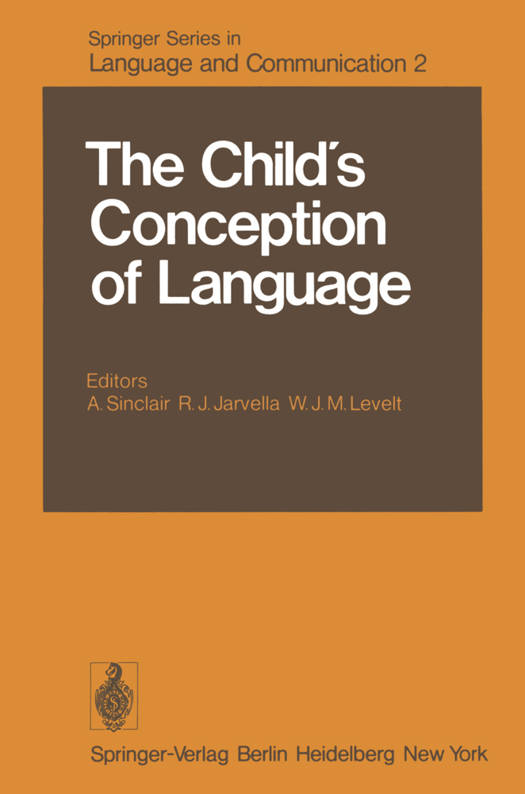
The Child's Conception of Language
€ 118,45
+ 236 punten
Omschrijving
It is obvious that the growing child manifests an increasing understanding of his language and facility to use it. A major part of the child lan- guage literature is concerned with the child's developing linguistic and communicative competence. Scattered evidence also shows, however, that children become progressively more aware of language as Zanguage. It is interesting to consider in what ways the internal structure and mechanisms of language become more accessible. Little is known about linguistic aware- ness of this kind, the role it plays, or how it develops. When the new Projektgruppe fUr Psycholinguistik of the Max-Planck- Gesellschaft was founded, "the child's conception .of language," in analogy to Piaget's "child's conception of the physical world," become one of the research unit's topics of study. As previous work on linguistic awareness was largely amorphous, we first organized a kind of conference workshop with some of those who had worked in the area. The aims of this meeting were to map out the field of study, detail the phenomena of interest, and define major theoretical issues. The meeting took place just after the creation of the project group, on May 3-7, 1977. The participants were psychologists and linguists who had either published work on metalinguistic issues in child language, or who could be expected to contribute substantially to the discussion. This book is a direct outcome of that conference, though it is not a complete reflection of the papers presented, or of the discussion that took place.
Specificaties
Betrokkenen
- Uitgeverij:
Inhoud
- Aantal bladzijden:
- 268
- Taal:
- Engels
- Reeks:
- Reeksnummer:
- nr. 2
Eigenschappen
- Productcode (EAN):
- 9783642671579
- Verschijningsdatum:
- 18/10/2011
- Uitvoering:
- Paperback
- Formaat:
- Trade paperback (VS)
- Afmetingen:
- 156 mm x 234 mm
- Gewicht:
- 403 g

Alleen bij Standaard Boekhandel
+ 236 punten op je klantenkaart van Standaard Boekhandel
Wedstrijd


Beoordelingen
We publiceren alleen reviews die voldoen aan de voorwaarden voor reviews. Bekijk onze voorwaarden voor reviews.