


- Afhalen na 1 uur in een winkel met voorraad
- Gratis thuislevering in België vanaf € 30
- Ruim aanbod met 7 miljoen producten
- Afhalen na 1 uur in een winkel met voorraad
- Gratis thuislevering in België vanaf € 30
- Ruim aanbod met 7 miljoen producten





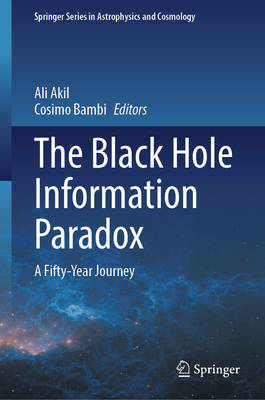
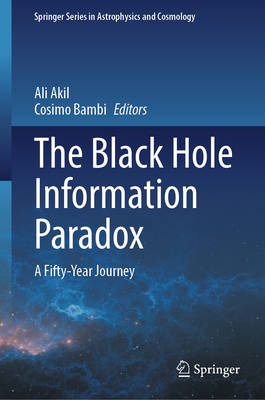
The Black Hole Information Paradox
A Fifty-Year Journey
€ 305,45
+ 610 punten
Omschrijving
This book reviews a few different derivations of the Hawking radiation, most main solutions to the paradox proposed in the literature, and some analog laboratory experiments. A black hole is an object whose gravity is so strong that nothing, not even light, can escape its grasp. However, applying quantum field theory on a black hole background, Stephen Hawking showed that black holes are not completely black. In fact, they seem to emit a form of radiation that was named the Hawking radiation. The Hawking radiation appears to be thermal and in a quantum state that is independent of the initial state that formed the black hole; instead, it solely depends on the black hole's total mass, spin, and electric charge. A problem arises when we consider an initial system that collapses, forms a black hole, and eventually the black hole evaporates completely through Hawking radiation. Since Hawking radiation depends solely on the black hole's total mass, spin, and electric charge, it implies that numerous distinct initial states could all lead to the same final state. Consequently, the intricate details of the initial state seem to be lost, which contradicts the unitarity of evolution of closed systems, a fundamental principle of quantum mechanics. The unitarity principle implies that closed systems evolve in a reversible manner, such that, knowing a system's final state, and the way it evolved, one can always determine its initial state. The many-to-one evolution of the black hole initial state to radiation evolution is in a clear contradiction with this principle. This is the black hole information paradox. The black hole information paradox was found in the 1970s by Stephen Hawking. Over the past 50 years, it has attracted a lot of interest in the theoretical physics community and is still an active research field. Chapters are written by leading experts in the field.
Specificaties
Betrokkenen
- Uitgeverij:
Inhoud
- Aantal bladzijden:
- 716
- Taal:
- Engels
- Reeks:
Eigenschappen
- Productcode (EAN):
- 9789819661695
- Verschijningsdatum:
- 30/08/2025
- Uitvoering:
- Hardcover
- Formaat:
- Genaaid
- Afmetingen:
- 156 mm x 234 mm
- Gewicht:
- 1183 g

Alleen bij Standaard Boekhandel
+ 610 punten op je klantenkaart van Standaard Boekhandel
AANGERADEN


Beoordelingen
We publiceren alleen reviews die voldoen aan de voorwaarden voor reviews. Bekijk onze voorwaarden voor reviews.