


- Afhalen na 1 uur in een winkel met voorraad
- Gratis thuislevering in België vanaf € 30
- Ruim aanbod met 7 miljoen producten
- Afhalen na 1 uur in een winkel met voorraad
- Gratis thuislevering in België vanaf € 30
- Ruim aanbod met 7 miljoen producten





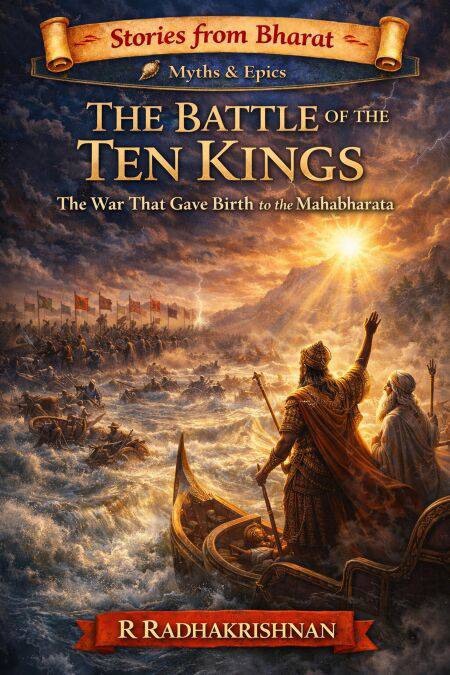
The Battle of the Ten Kings: The War That Gave Birth to the Mahabharata E-BOOK
Stories from Bharat, #2
R Radhakrishnan
€ 3,49
+ 3 punten
Eenvoudig bestellen
Veilig betalen


Onmiddellijk geleverd via e-mail
Omschrijving
Before the Mahabharata, there was a battle that made it possible.
Over three thousand years ago, on the banks of a flooding river in what is now Punjab, one of history's most consequential, and most forgotten, wars was fought. Ten kings rode out together to crush a single man. They failed. And the world that rose from the wreckage of their defeat eventually gave birth to the Kuru kingdom, the Vedic civilisation, and the greatest epic ever written.
This is the story of the Dasarajna Yuddha. The Battle of the Ten Kings; preserved in the oldest surviving literature on earth: the Rigveda.
At its heart are three extraordinary men. King Sudas of the Trtsu-Bharata tribe; a warrior-king of uncommon brilliance whose westward expansion was reshaping the ancient world. Vishvamitra, the most gifted priest of his age, who guided Sudas to glory, was cast aside, and in his wounded fury assembled the most dangerous coalition the Vedic world had ever seen. And Vasistha, Vishvamitra's great rival, who replaced him at Sudas's side, won the war with hymns as sharp as swords, and then did something rarer than victory: he built a lasting peace.
But this is more than a war story. It is the story of how a battle becomes a civilisation. How the defeated Puru tribe merged with the victorious Bharatas to forge the Kuru kingdom — India's first attested state-level society. How a displaced and furious priest walked east into exile and, refusing to stay defeated, built a rival sphere of influence so extraordinary that mythology transformed it into a story about a man who tried to construct a new heaven. And how that ancient rivalry between two priestly lineages was eventually reconciled, finding its echo centuries later in the Mahabharata's fratricidal war on the plains of Kurukshetra.
Drawing various sources and the stories he heard over the decades, Radhakrishnan, in, The Battle of the Ten Kings reconstructs a pivotal moment in Indian history with the pace and drama it deserves — told not as a dry academic exercise but as what it truly was: a story of ambition, betrayal, exile, flood, divine intervention, and the stubborn human refusal to be erased.
The hymns Vasistha composed on the banks of the Parusni that day still exist. They are the oldest war poetry on Earth. This is the story they were written to celebrate.
Specificaties
Betrokkenen
- Auteur(s):
- Uitgeverij:
Inhoud
- Taal:
- Engels
- Reeks:
Eigenschappen
- Productcode (EAN):
- 9798233489723
- Verschijningsdatum:
- 21/02/2026
- Uitvoering:
- E-book
- Beveiligd met:
- Adobe DRM
- Formaat:
- ePub


Alleen bij Standaard Boekhandel
+ 3 punten op je klantenkaart van Standaard Boekhandel
CADEAU

AANGERADEN


Beoordelingen
We publiceren alleen reviews die voldoen aan de voorwaarden voor reviews. Bekijk onze voorwaarden voor reviews.