


- Afhalen na 1 uur in een winkel met voorraad
- Gratis thuislevering in België vanaf € 30
- Ruim aanbod met 7 miljoen producten
- Afhalen na 1 uur in een winkel met voorraad
- Gratis thuislevering in België vanaf € 30
- Ruim aanbod met 7 miljoen producten





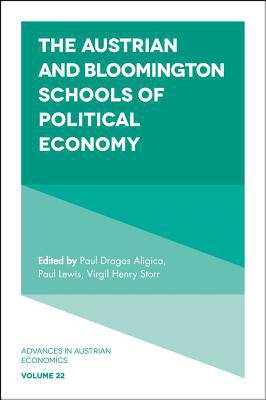
The Austrian and Bloomington Schools of Political Economy
€ 228,95
+ 457 punten
Omschrijving
The relationship between the Austrian tradition and Bloomington institutionalism has been part of a larger intellectual evolution of a family of schools of thought that coevolved in multiple streams over the last 100 years or so. The Bloomington scholars, once they delineated the broader parameters of their own research program, started to reconstruct, reinterpret, and in many cases simply rediscover and reinvent Austrian insights and themes. As such, they created the possibility of giving those insights and themes new interpretations and new applications, in novel circumstances with new research priorities, in particular, public administration, governance and collective action, and entrepreneurship in non-market settings.
Was there a programmatic and explicit effort to recover and reinvent the Austrian tradition? The answer has to be an emphatic 'no'. But that is precisely the reason why the Ostroms' work should be interesting to scholars working in the Austrian tradition. The thematic convergence and the compatibility and complementarity between the Austrian and Bloomington schools is driven by their internal underlying theoretical logic and by the logic of problem solving. Upon closer inspection, the underlying familial and genealogical connections reveal themselves again and again.
The convergence and interplay between these two intellectual traditions is rich and productive. On the one hand, it stands as a demonstration of the applied relevance of the set of approaches and issues that we traditionally associate with the Austrian tradition. On the other hand, it is a challenge to further explore and elaborate this area. This volume is an attempt to respond to that challenge.
Was there a programmatic and explicit effort to recover and reinvent the Austrian tradition? The answer has to be an emphatic 'no'. But that is precisely the reason why the Ostroms' work should be interesting to scholars working in the Austrian tradition. The thematic convergence and the compatibility and complementarity between the Austrian and Bloomington schools is driven by their internal underlying theoretical logic and by the logic of problem solving. Upon closer inspection, the underlying familial and genealogical connections reveal themselves again and again.
The convergence and interplay between these two intellectual traditions is rich and productive. On the one hand, it stands as a demonstration of the applied relevance of the set of approaches and issues that we traditionally associate with the Austrian tradition. On the other hand, it is a challenge to further explore and elaborate this area. This volume is an attempt to respond to that challenge.
Specificaties
Betrokkenen
- Uitgeverij:
Inhoud
- Aantal bladzijden:
- 200
- Taal:
- Engels
- Reeks:
- Reeksnummer:
- nr. 22
Eigenschappen
- Productcode (EAN):
- 9781787148444
- Verschijningsdatum:
- 2/11/2017
- Uitvoering:
- Hardcover
- Formaat:
- Genaaid
- Afmetingen:
- 155 mm x 231 mm
- Gewicht:
- 381 g

Alleen bij Standaard Boekhandel
+ 457 punten op je klantenkaart van Standaard Boekhandel
Cadeau

AANGERADEN


Beoordelingen
We publiceren alleen reviews die voldoen aan de voorwaarden voor reviews. Bekijk onze voorwaarden voor reviews.