


- Afhalen na 1 uur in een winkel met voorraad
- Gratis thuislevering in België vanaf € 30
- Ruim aanbod met 7 miljoen producten
- Afhalen na 1 uur in een winkel met voorraad
- Gratis thuislevering in België vanaf € 30
- Ruim aanbod met 7 miljoen producten





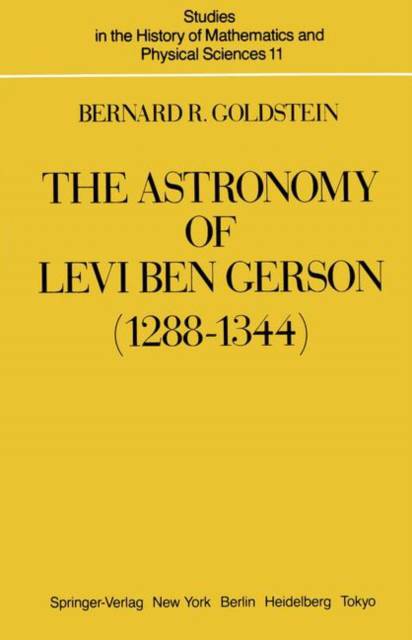
The Astronomy of Levi Ben Gerson (1288-1344)
A Critical Edition of Chapters 1-20 with Translation and Commentary
Bernard R Goldstein
€ 111,95
+ 223 punten
Omschrijving
It would seem that S. Munk was the first modern scholar to draw attention to the significance of Levi ben Gerson's Astronomy, surely the most original work on astronomy written in Hebrew in the Middle Ages. Munk (1859, p. 500) called for a specialist to undertake a serious study of this work, but there was little response to his plea in the succeeding century. Indeed, this is the first edition of the Hebrew text of any part of Levi's Astronomy but for the table of contents (Renan, 1893, pp. 624-32), and the poems celebrating the invention of the Jacob Staff that appear in chapter 9 (Carlebach, 191Oa, pp. 152-53). The text of Levi's Astronomy is written in a ponderous Hebrew style but the content sparkles with originality. The Ptolemaic tradition is subjected to a profound critique based on the idea that the planetary models must conform both to Levi's own observations as well as those of the ancients, and the claim that astronomical theory must be philosophically sound. The enduring vigor of the Ptolemaic tradition has been characterized by O. Neugebauer as fol- lows: "There is no better way to convince oneself of the inner coherence of ancient and medieval astronomy than to place side by side the Almagest, al- BaWini's Opus astronomicum and Copernicus's De Revolutionibus. Chapter by chapter, theorem by theorem, table by table, these works run parallel" (1957, pp. 205-6).
Specificaties
Betrokkenen
- Auteur(s):
- Uitgeverij:
Inhoud
- Aantal bladzijden:
- 312
- Taal:
- Engels
- Reeks:
- Reeksnummer:
- nr. 11
Eigenschappen
- Productcode (EAN):
- 9781461385714
- Verschijningsdatum:
- 8/11/2011
- Uitvoering:
- Paperback
- Formaat:
- Trade paperback (VS)
- Afmetingen:
- 156 mm x 234 mm
- Gewicht:
- 458 g



Alleen bij Standaard Boekhandel
+ 223 punten op je klantenkaart van Standaard Boekhandel
Cadeau

AANGERADEN


Beoordelingen
We publiceren alleen reviews die voldoen aan de voorwaarden voor reviews. Bekijk onze voorwaarden voor reviews.