


- Afhalen na 1 uur in een winkel met voorraad
- Gratis thuislevering in België vanaf € 30
- Ruim aanbod met 7 miljoen producten
- Afhalen na 1 uur in een winkel met voorraad
- Gratis thuislevering in België vanaf € 30
- Ruim aanbod met 7 miljoen producten





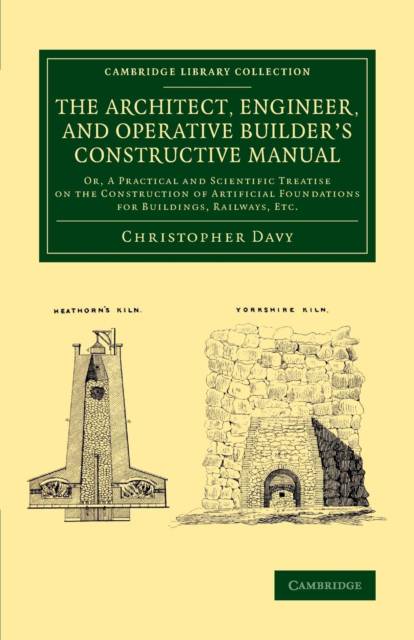
The Architect, Engineer, and Operative Builder's Constructive Manual
Or, a Practical and Scientific Treatise on the Construction of Artificial Foundations for Buildings, Railways, Etc.
Christopher Davy
€ 75,95
+ 151 punten
Omschrijving
Little is known about Christopher Davy (c.1803-49), despite his regular contributions to architectural and engineering magazines in Britain and America. Describing himself as an 'architect and teacher of architecture', he also took an interest in steam engines and railway construction. In this work, published in 1839, and using information gathered from experiments by the Board of Ordnance, Davy begins by describing the characteristics of the geology of England and Wales, with regard to its suitability for obtaining building materials and laying strong foundations. He describes the means by which soil and rock samples may be taken, and gives details relating to the construction of the foundations of St Paul's Cathedral on the troublesome London clay. Later chapters discuss the practicalities of pile driving, the use of concrete, and the properties of limestone. Reflecting the progress of technical knowledge in the early nineteenth century, the work features several illustrations of contemporary apparatus.
Specificaties
Betrokkenen
- Auteur(s):
- Uitgeverij:
Inhoud
- Aantal bladzijden:
- 272
- Taal:
- Engels
- Reeks:
Eigenschappen
- Productcode (EAN):
- 9781108070690
- Verschijningsdatum:
- 10/07/2014
- Uitvoering:
- Paperback
- Formaat:
- Trade paperback (VS)
- Afmetingen:
- 140 mm x 216 mm
- Gewicht:
- 349 g


Alleen bij Standaard Boekhandel
+ 151 punten op je klantenkaart van Standaard Boekhandel
Cadeau

AANGERADEN


Beoordelingen
We publiceren alleen reviews die voldoen aan de voorwaarden voor reviews. Bekijk onze voorwaarden voor reviews.