


- Afhalen na 1 uur in een winkel met voorraad
- Gratis thuislevering in België vanaf € 30
- Ruim aanbod met 7 miljoen producten
- Afhalen na 1 uur in een winkel met voorraad
- Gratis thuislevering in België vanaf € 30
- Ruim aanbod met 7 miljoen producten





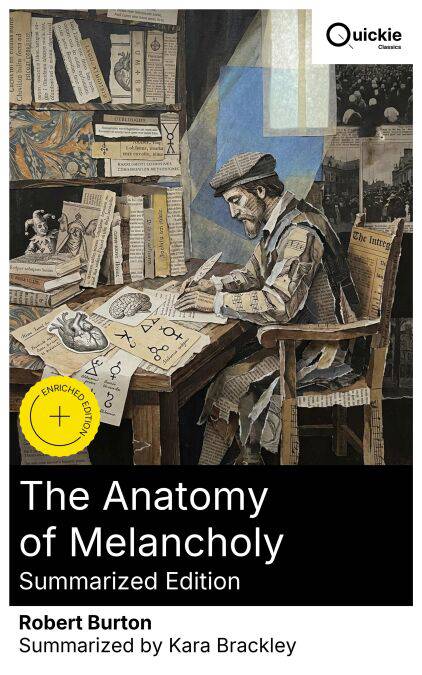
The Anatomy of Melancholy (Summarized Edition) E-BOOK
Enriched edition. A 17th‑Century Inquiry into Melancholy: Philosophy, Medicine, and Humor in the Study of the Human Condition
Robert Burton
E-book | Engels
€ 0,49
Omschrijving
First published in 1621 under the persona "Democritus Junior," The Anatomy of Melancholy is an encyclopedic inquiry into sadness that ranges across medicine, philosophy, theology, and poetry. Organized into learned partitions on causes, symptoms, and cures, it surveys humoral physiology, lovesickness, religious despair, and civic malaise, proposing regimens of diet, exercise, music, friendship, and physic. Burton's baroque, digressive prose, thick with classical citations and sly satire, embodies the early modern commonplace tradition, turning marginalia into method and making the book a polyphonic laboratory of the mind. Robert Burton, an Oxford scholar and cleric, lived amid the libraries and debates of early Stuart England, where scholarship, medicine, and theology interpenetrated. Afflicted, by his own account, with recurring melancholy, he read voraciously and revised the work through multiple expanded editions. His erudition, pastoral experience, and self-experimentation converge to produce a study that is at once clinical, moral, and comic. Readers of intellectual history, literature, or psychology will find in Burton a companionable guide whose wit and compassion remain startlingly modern. Approach this book for its learned consolations, its taxonomy of sorrow, and its exuberant style; stay for the sense that, across centuries, the anatomy it dissects is recognizably our own.
Quickie Classics summarizes timeless works with precision, preserving the author's voice and keeping the prose clear, fast, and readable—distilled, never diluted. Enriched Edition extras: Introduction · Synopsis · Historical Context · Brief Analysis · 4 Reflection Q&As · Editorial Footnotes.
Quickie Classics summarizes timeless works with precision, preserving the author's voice and keeping the prose clear, fast, and readable—distilled, never diluted. Enriched Edition extras: Introduction · Synopsis · Historical Context · Brief Analysis · 4 Reflection Q&As · Editorial Footnotes.
Specificaties
Betrokkenen
- Auteur(s):
- Uitgeverij:
Inhoud
- Aantal bladzijden:
- 389
- Taal:
- Engels
Eigenschappen
- Productcode (EAN):
- 8596547878872
- Verschijningsdatum:
- 9/01/2026
- Uitvoering:
- E-book
- Beveiligd met:
- Digital watermarking
- Formaat:
- ePub


Alleen bij Standaard Boekhandel
Cadeau

AANGERADEN


Beoordelingen
We publiceren alleen reviews die voldoen aan de voorwaarden voor reviews. Bekijk onze voorwaarden voor reviews.